FILE 03 // EST. 1876 // STATUS: THE PARALLEL LINEAGE — NEVER RECONCILED
ANARCHO-COMMUNISM
Communism without the state, ever, at any stage: free federation of communes,
mutual aid, and the standing prediction — made in 1873, checked in 1921 and 1937 — that a
workers' state would eat its workers.
NO GODS NO MASTERSMETHOD: DIRECT ACTIONTRANSITION PERIOD: REFUSED
SPAWNED FROM
Proudhon's mutualism, Bakunin's collectivism — the anti-authoritarian wing of the First International
Anarchism entered the archive shouting. Pierre-Joseph Proudhon opened in 1840 with the most
quotable accusation in political theory — "property is theft" — and the first self-applied use of the
word "anarchist." Mikhail Bakunin, a Russian noble who spent years chained in fortresses and
escaped across three continents, gave the current its revolutionary form and its great prophecy: Marx's
workers' state, he warned, would produce "a new class, a new hierarchy" of red bureaucrats. The quarrel
consumed the First International; Marx won the procedural war in 1872, and the two lineages have run
parallel — and unreconciled — ever since.
The specifically communist variant crystallized in the Italian and Jura federations after
1876: Cafiero, Malatesta, and above all Peter Kropotkin — geographer, prince, ex-prisoner —
argued that Bakunin's collectivism (pay by work done) still smuggled in the wage. Full communism:
common storehouse, free access, "to each according to need." Kropotkin spent the 1890s giving the
idea a scientific footing: Mutual Aid marshalled biology to show cooperation, not competition,
as a factor of evolution; The Conquest of Bread costed out the free commune down to the hours
of the working day.
02 Core Doctrine
The state is the enemy — all of it
Not a neutral machine to be seized but a social relation that manufactures rulers. A "workers'
state" is a contradiction that resolves itself, quickly, in favour of the state. The revolution must
abolish it on day one, not administer it toward withering.
Free federation
Coordination without command: communes and workplaces federate from the bottom up by voluntary
pact, with delegates mandated and recallable. The pyramid is inverted or it is a pyramid.
The common storehouse
Immediate communism in distribution — no wages, no ration-by-work, no transitional bookkeeping.
Kropotkin's argument: production is already social; only the ledger pretends otherwise.
Mutual aid
Cooperation is older than capitalism and sturdier than decree. Species — and villages, guilds and
communes — survive by solidarity. The new society is not built from scratch; it is disinterred.
Direct action & prefiguration
Means make ends: strikes, occupations, expropriation, and communes built now. An emancipation
delivered by a party is a new subjection with better posters.
"When the people are being beaten with a stick, they are not much happier
if it is called 'the People's Stick.'"— BAKUNIN, STATISM AND ANARCHY (1873)
03 Key Figures
MIKHAIL BAKUNIN 1814–1876 // the prophecy
PETER KROPOTKIN 1842–1921 // the science and the bread
EMMA GOLDMAN 1869–1940 // the voice, and the witness at Kronstadt
04 In Practice
The school's laboratories were brief and bright. Makhno's Free Territory in Ukraine
(1918–1921): seven million people, free communes and an insurgent army that fought Whites and Reds
alternately — until Trotsky's Red Army, done using it, destroyed it. Revolutionary Catalonia
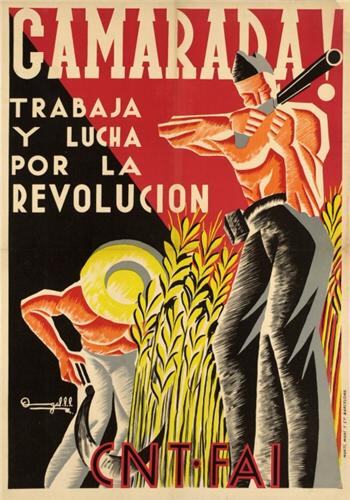
(1936–1937): the CNT's two million members collectivized farms, factories, even the Barcelona tramways,
which ran better and cheaper under the workers — the largest anarchist experiment in history, strangled
not by Franco first but by its Stalinist allies in the May Days of 1937. Orwell watched, took a bullet
in the throat, and filed the report as Homage to Catalonia.
Since then the practice has dispersed rather than died: the Zapatista municipalities in Chiapas and
the communes of Rojava run recognizably anarchist-communist machinery under other names, and every
mutual-aid network stood up in a disaster is Kropotkin's footnote made flesh.
05 Schisms & Enemies
vs. Marxism (1872). The founding split — Schism №1. State as
weapon versus state as enemy. Both sides still cite it like case law.
vs. Bolshevism (1918–1921). The anarchists backed October, then became its first victims:
the Cheka closed their presses, Makhno was betrayed, and Kronstadt's sailors — demanding "soviets
without parties" — were machine-gunned across the ice while Kropotkin's funeral was still fresh.
For anarchists, Bakunin's prophecy confirmed within four years.
vs. Stalinism (1937). Barcelona's May Days: Communist-led police against anarchist workers,
inside the antifascist camp, mid-civil-war. The POUM and CNT never recovered; neither did the alliance.
internal: the organization question. Platformists (tight federations) versus synthesists
(loose ones) versus individualists (none) — anarchism schisms too; it just doesn't shoot the losers.
06 Timeline
1840Proudhon: What Is Property? — "property is theft."
1872Hague Congress expels Bakunin; anti-authoritarians regroup at St. Imier.
1876Italian Federation declares for anarchist communism; Bakunin dies.
1892Kropotkin's The Conquest of Bread.
1918Makhno's Free Territory rises in Ukraine.
1921Kronstadt crushed; Kropotkin's funeral is the last legal anarchist demonstration in Russia.
1936Revolutionary Catalonia: the CNT collectivizes half the economy.
1937May Days in Barcelona; the experiment is suppressed from within.
1994Zapatista uprising: the lineage returns in Chiapas.
07 Legacy
Anarcho-communism is the archive's control group: the school that never held a state and therefore
never produced a purge, a famine or a secret police — and never held a state. Its wager — that means
determine ends, that the stick renamed is the stick still — is the standing cross-examination of every
other file here. The movements keep returning to it precisely when the party-states discredit
themselves, which is to say: regularly.
08 Plates
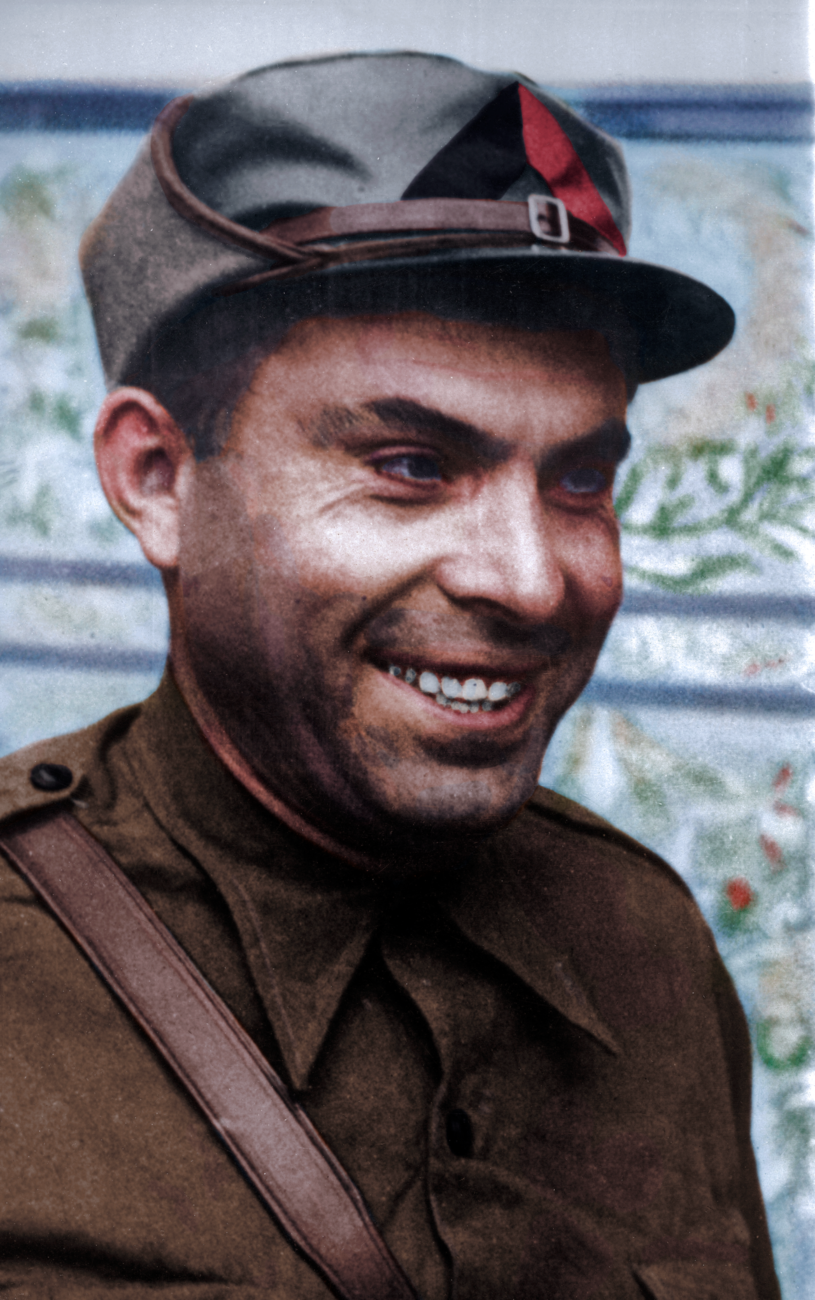
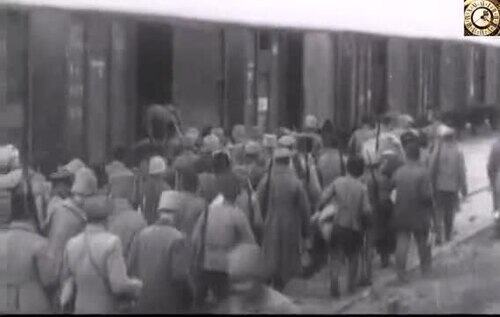
The lineage that refused the party and the transitional state, photographed where it held territory: Spain in 1936 and the Ukrainian steppe in 1919.
Spain 1936 // CNT-FAI — "Comrade, work and fight for the revolution"Durruti // the column commander, dead at the Madrid front in November 19361919 // Makhno's insurgents — the other army that fought the Whites, then the Reds
Plates are vendored from Wikimedia Commons under their own licences and re-encoded to web size; the credit for each is listed in the Plate Room.