FILE 02 // EST. 1848 // STATUS: SOURCE CODE — ALL LATER FILES ARE FORKS
MARXISM
Historical materialism, surplus value, class struggle: the operating system
every other school in this archive runs on, argues with, or claims to have patched.
THE TRUNKMETHOD: SCIENCE OF HISTORYSPECTRE STATUS: HAUNTING
Karl Marx arrived at communism sideways: a Rhineland doctor's son, trained in Hegelian philosophy,
radicalized by editing a newspaper the Prussian censors kept shutting down. Exiled to Paris in 1843,
he met Friedrich Engels — a Manchester mill-owner's son who had just written the definitive
exposé of English working-class misery. The partnership was asymmetric and permanent: Marx wrote the
system; Engels funded it, popularized it, and finished it after Marx's death.
Their move was to fuse three national traditions into one machine. From German philosophy
they took Hegel's dialectic — history advances through contradiction — and stood it "on its feet":
the motor of history is not Spirit but material production. From English political economy
they took Ricardo's labour theory of value and turned it against its owners. From French politics
they took the revolution itself, and its most radical conclusion: Babeuf's demand that equality be
made real in property, not just law.
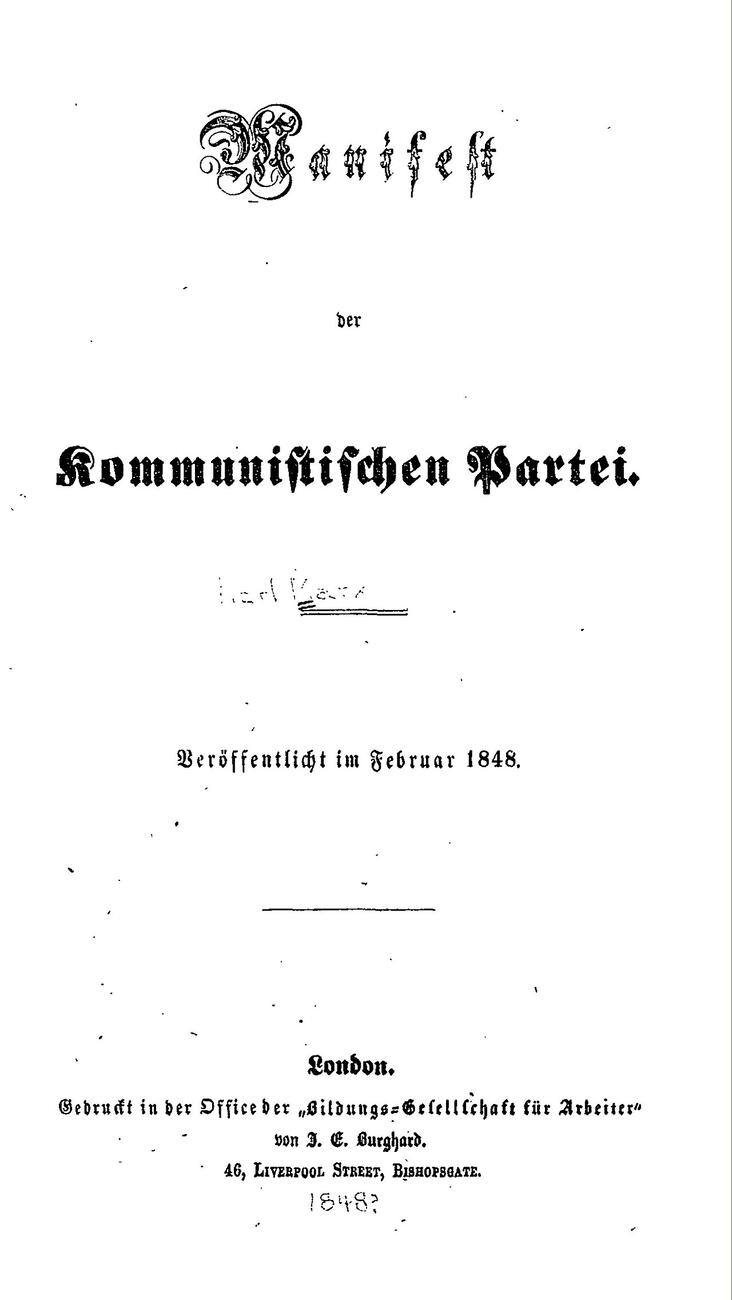
In February 1848, weeks before revolutions detonated across Europe, the Communist League published
their commissioned program. The Communist Manifesto opens with a séance — "a spectre is haunting
Europe" — and closes with a threat the twentieth century took literally: the proletarians have nothing
to lose but their chains.
02 Core Doctrine
Historical materialism
The way a society produces its material life — who owns the tools, who does the work — determines
its politics, law and ideas. History is the sequence of these "modes of production": slavery,
feudalism, capitalism, and next, allegedly, socialism. "The history of all hitherto existing
society is the history of class struggles."
Surplus value
The core accusation of Capital (1867). Workers are paid for their labour-power, but produce
more value than that wage; the difference — surplus value — is the source of all profit. Exploitation
is therefore not a moral failure of bad capitalists but the definition of the wage relation itself.
Class struggle
Capitalism simplifies society into two great camps: bourgeoisie (owners of the means of production)
and proletariat (owners of nothing but labour-power). Their interests are irreconcilable; the struggle
between them is the engine that will end the system.
Crisis and gravediggers
Competition forces capital to concentrate, mechanize and periodically crash. Each crisis is larger;
each round proletarianizes more of society. Capitalism thus "produces its own gravediggers" —
collapse is tendential, not accidental.
Dictatorship of the proletariat
Between capitalism and communism lies a transition in which the working class holds state power
and expropriates the expropriators. Marx left the details fatally vague — two sentences in the
Critique of the Gotha Programme onto which every later school projected its own state, or
its absence.
Communism
The end state: classless, stateless, moneyless; production for use, not exchange. "From each
according to his ability, to each according to his needs." Marx wrote perhaps ten pages on it
in forty years — the sparsest blueprint ever fought over this hard.
"The philosophers have only interpreted the world, in various ways.
The point, however, is to change it."— MARX, THESES ON FEUERBACH (1845)
03 Key Figures
KARL MARX 1818–1883 // the system
FRIEDRICH ENGELS 1820–1895 // the general, the funder, the editor
04 In Practice
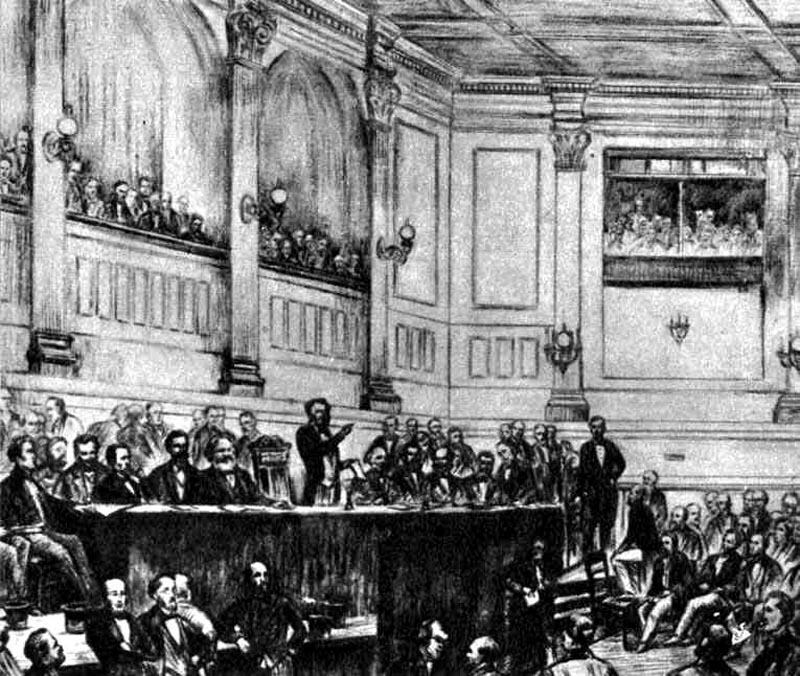
Marx's own political practice was the First International (1864–1876) — a fractious coalition
of Marxists, anarchists and trade unionists that he steered, dominated and ultimately broke rather than
surrender to Bakunin. The Paris Commune of 1871 gave him his one glimpse of the proletariat in
power: seventy-two days of elected, recallable, workers'-wage government, drowned in blood. His verdict
in The Civil War in France — the working class cannot simply lay hold of the ready-made state
machinery — became scripture for every later school, each reading it differently.
Marx died in 1883 stateless, two volumes of Capital unfinished on his desk. He never governed
anything, which is precisely why every school that did governs in his name: the source code ships
without an implementation, and the forks have been fighting over the build ever since.
05 Schisms & Enemies
vs. Bakunin (1864–1872). The First International's civil war: workers' state versus no state.
Marx won the vote at The Hague and lost the organization — see Schism №1.
vs. the utopians. A friendly burial: honoured as pioneers, dismissed as dreamers.
"Scientific" socialism defined itself against the model-village method.
vs. its own heirs. Marx, reading French "Marxists" in his last years, remarked:
"what is certain is that I am not a Marxist." The archive's most prophetic sentence.
06 Timeline
1818Marx born in Trier; Engels in Barmen, 1820.
1844Paris: the partnership begins; Marx drafts the Economic and Philosophic Manuscripts.
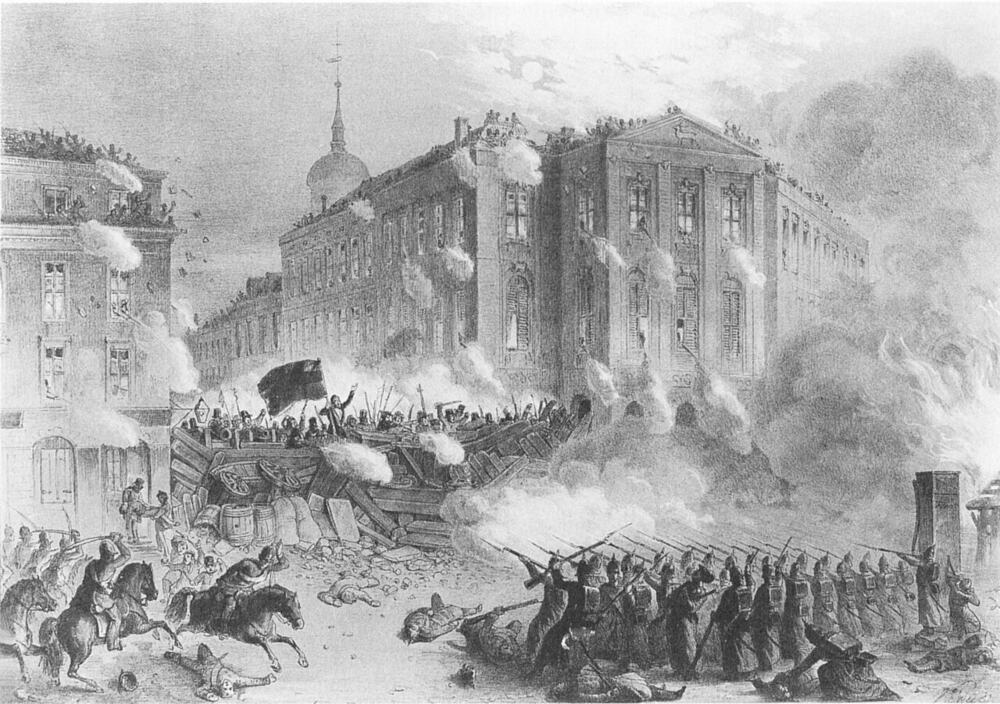
1848The Communist Manifesto; revolutions across Europe fail; Marx exiled to London for life.
1864First International founded in St. Martin's Hall, London.
1867Capital Volume I published in Hamburg.
1871The Paris Commune rises and falls; Marx defends it in The Civil War in France.
1872Hague Congress: Bakunin expelled; the International effectively ends.
1875Critique of the Gotha Programme — the ten pages on communism itself.
1883Marx dies; Engels edits Volumes II–III and systematizes the doctrine until 1895.
07 Legacy
Every file in this archive is a reading of this one. The orthodox waited for the science to complete
itself; Lenin built a party to force the timetable; Luxemburg trusted the masses; the Western Marxists
took the analysis into culture; the anarchists kept the goal and burned the transitional state.
Beyond the movement, Marx's diagnostic half — crisis theory, class analysis, the critique of ideology —
was absorbed into the social sciences wholesale. The prescription remains, to put it gently, contested.
08 Plates
The source documents and the year they were written into. February 1848 put the pamphlet in print; by June the barricades were up across Europe, and neither event caused the other.
1848 // Manifest der Kommunistischen Partei — twenty-three pages, printed in LondonMarch 1848 // the Alexanderplatz — the revolution the Manifesto arrived just too late to shape1864 // the founding of the First International — Marx writes the inaugural address
Plates are vendored from Wikimedia Commons under their own licences and re-encoded to web size; the credit for each is listed in the Plate Room.