FILE 16 // EST. 1955 // SEAT: PYONGYANG // STATUS: THE SCHOOL THAT LEFT THE FAMILY
JUCHE
Self-reliance as state religion: Korea's man-centred rewrite of
Marxism–Leninism, in which the masses are the masters of history, the Leader is the
master of the masses, and the revolution is inherited by bloodline.
SELF-RELIANCE (自主)METHOD: THE MONOLITHIC LINEMARX: CITED, THEN DELETED
Korean nationalism & the guerrilla myth — Mt. Paektu as founding scripture
SPAWNED
Songun ("military first") — the 1990s extension
Kimilsungism–Kimjongilism — the ideology renamed for its owners
SCHISMS
vs. Soviet & Chinese tutelage — navigated, never declared
vs. Marxism itself — quietly, clause by constitutional clause
01 Origin Vector
Kim Il-sung arrived in 1945 as a thirty-three-year-old guerrilla captain in a Soviet
uniform, installed by Moscow in its half of a peninsula partitioned in an afternoon. The apprentice
learned the sponsor's lessons — purge rivals early, write the history yourself — and then the
Korean War burned the sponsorship into resentment: Soviet caution, Chinese armies on Korean soil,
and an armistice signed over his head taught Kim what dependence costs.
The word arrived in December 1955, in a speech scolding party propagandists for copying Soviet
models: juche — subjecthood, self-reliance — "the revolution in our country is our
revolution." What began as a bureaucratic slap became, through the 1960s, a doctrine; through the
1970s (systematized by ideologue Hwang Jang-yop, who later defected and denounced his own creation),
a philosophy; and by the 1972 constitution, the state ideology outright. The genius of the move was
diplomatic as much as doctrinal: positioned between quarrelling Moscow and Beijing
(Schism №10), Pyongyang used self-reliance to take aid from both
and orders from neither.
02 Core Doctrine
Man is the master
The official philosophy: man, not material forces, decides everything — "man is the master of
everything and decides everything." Marxism's economics demoted; will, consciousness and
organization promoted. Determinism out, voluntarism in.
The three pillars
Chaju (political independence), charip (economic self-sufficiency), chawi
(military self-defense). No flunkeyism (sadae — serving the great, the sin of Korea's
old elites), no dependence, no imported line.
The Leader theory
The masses are the motor of history, but only when given consciousness by the party, which is
given consciousness by the Suryong — the Leader. The "socio-political organism": Leader as
brain, party as nerves, masses as body. Cells do not vote on the brain.
The Monolithic Ideological System
The Ten Principles (1974) — memorized by every citizen — establish the Leader's word as the
sole interpretive authority, and his family line ("the Mt. Paektu bloodline") as its custodian.
The archive notes this solves, by heredity, the succession problem that broke every other file
in the building.
Songun
"Military first" (1990s): with the socialist bloc gone and famine at the door, the army becomes
the revolution's core institution and first claimant on resources. Juche's survival patch,
running since.
03 Key Figures
KIM IL-SUNG 1912–1994 // Eternal President — the title is literal and posthumous
04 In Practice
For its first decades the model looked, from a distance, like a contender: postwar reconstruction
outpaced the South into the 1960s, heavy industry rose on Soviet and Chinese aid discreetly rebadged
as self-reliance, and Pyongyang's delegations toured the Non-Aligned world selling Juche as the
decolonized future. The bill arrived with the sponsors' collapse: cut off in 1991, the self-reliant
economy proved to have been reliant after all. The 1990s famine — the "Arduous March" — killed
hundreds of thousands at minimum; the state answered with Songun, markets tolerated at the margins,
and, from 2006, nuclear tests: chawi achieved in its most literal isotope.
Doctrinally, the founders were edited out with characteristic patience: Marxism–Leninism lost its
constitutional billing in 1992, the last reference to communism itself was deleted in 2009, and the
ideology now answers to "Kimilsungism–Kimjongilism." Three generations — Kim Il-sung, Kim Jong-il,
Kim Jong-un — have now held the office the first still occupies eternally. Every other school in
this archive files Juche somewhere between apostasy and monarchy; Juche, consistent to the last,
does not ask for their recognition.
05 Schisms & Enemies
vs. tutelage, both flavors. The August 1956 faction incident: pro-Soviet and pro-Chinese
party factions moved against Kim and were purged — the only case on record of Moscow and Beijing
jointly intervening to reverse a purge, and failing. Juche's true founding date, by the archive's
reckoning.
vs. Marxism, by subtraction. No formal schism was ever declared; the classics were simply
cited less each decade until the constitution forgot them. The quietest apostasy on file.
vs. its own theorist. Hwang Jang-yop, Juche's chief systematizer, defected south in 1997
and spent his remaining years explaining that the humanism he drafted had been rebuilt into a
"theology of the Leader." The file retains both versions.
06 Timeline
1945Kim installed in the Soviet zone; the DPRK founded 1948.
1950–53The Korean War: dependence experienced, resented, filed.
1955December: the Juche speech against copying Soviet models.
1956The August faction purge; both patrons defied successfully.
1972Juche enters the constitution as the state ideology.
1974The Ten Principles; Kim Jong-il anointed within the decade.
1991–94Sponsors vanish; Kim Il-sung dies, becomes Eternal President.
1994–98The Arduous March famine; Songun proclaimed.
2009"Communism" deleted from the constitution.
2011–NOWThird-generation succession; the doctrine outlives its entire family tree of origin.
07 Legacy
Juche is the archive's limit case: what happens when the vanguard party's logic — the line above
the class, the Leader above the line — is run to completion without external correction. It solved
problems that destroyed its siblings (succession, de-Stalinization, bloc collapse) and paid with
everything else. As theory it has no serious foreign adherents left; as practice it administers
twenty-five million people and a nuclear arsenal, which is more than most files in this building
can currently claim. The archive shelves it under both "communism" and "departure from," and lets
the reader file the difference.
Archive clip // DPRKArchive clip // Long live North Korea
08 Plates
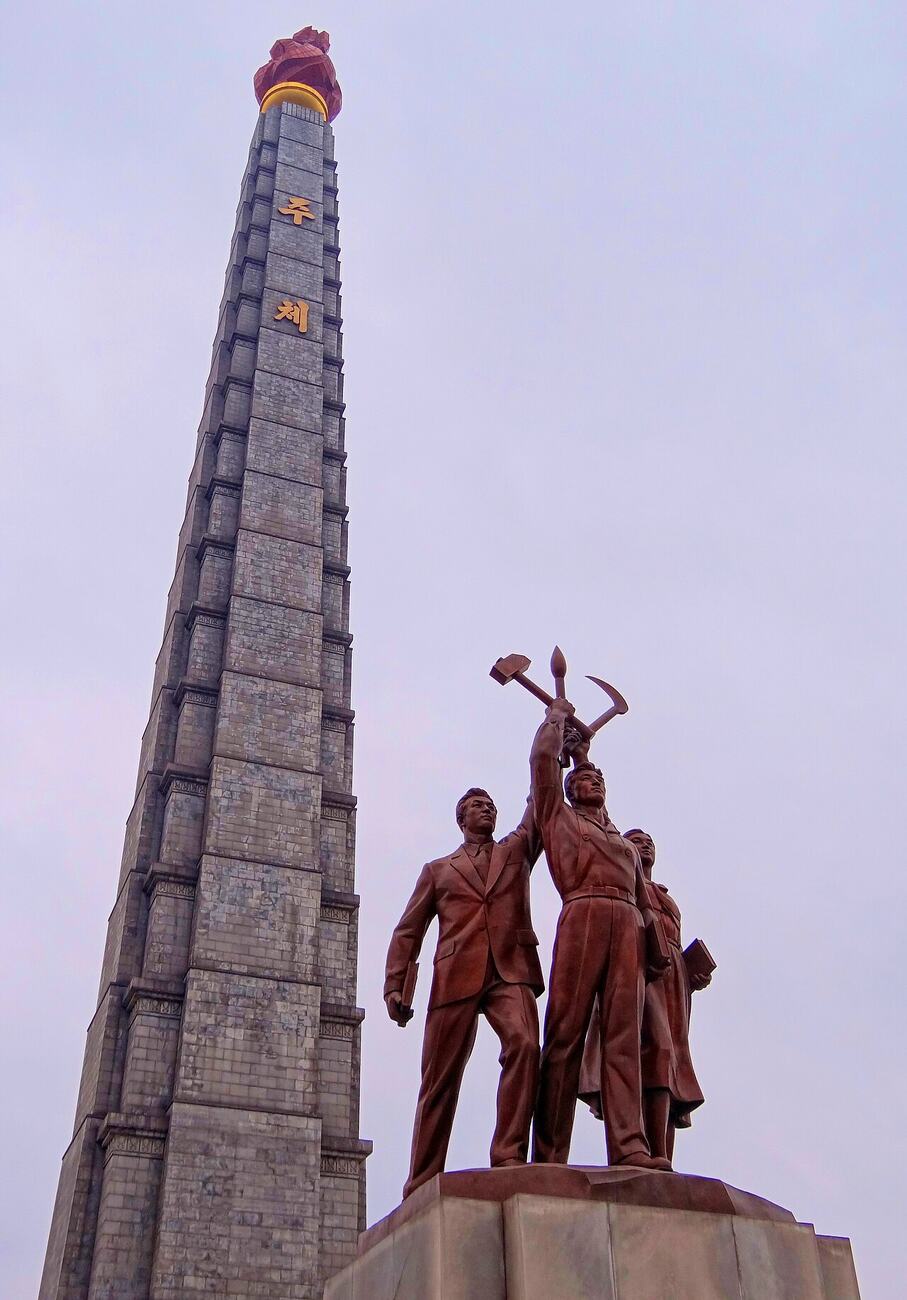
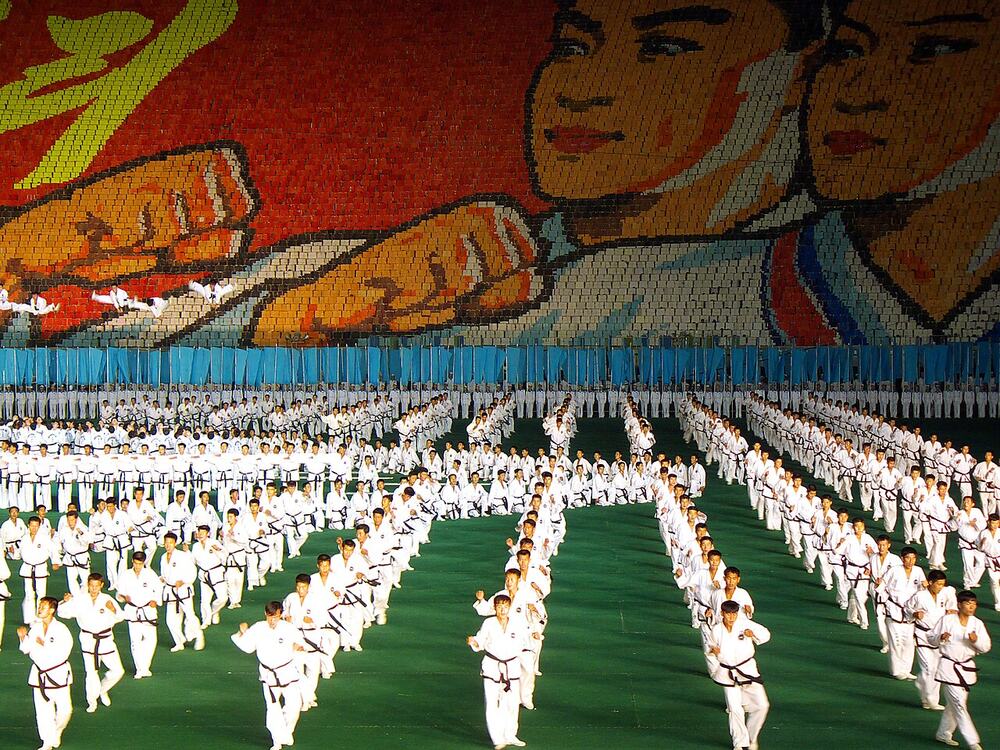
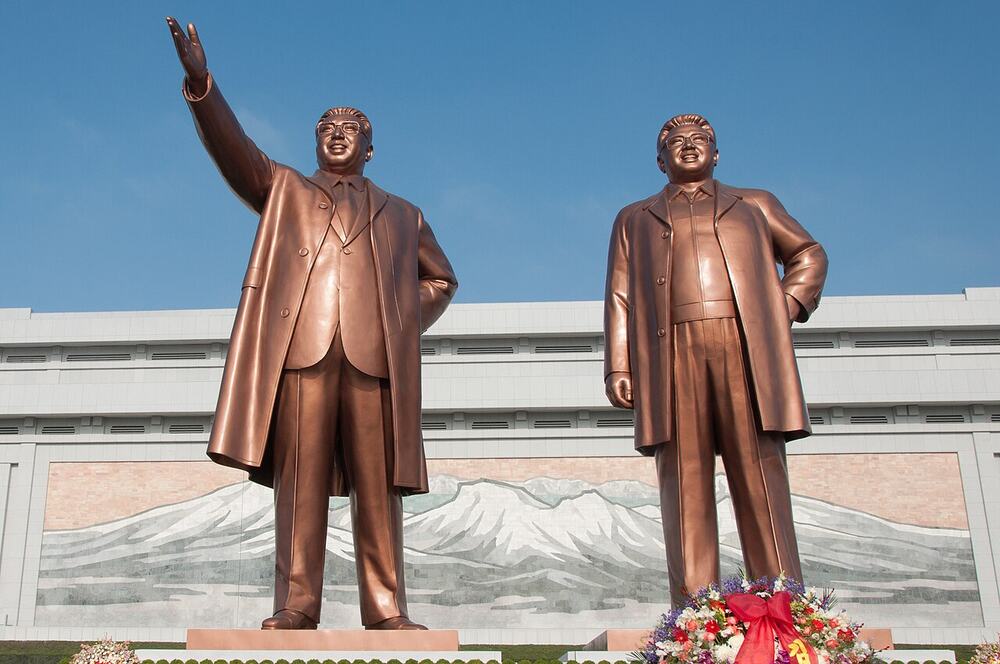
The doctrine that wrote Marxism-Leninism out of its own constitution, photographed in the three forms it takes in Pyongyang: the tower, the games and the statues.
Pyongyang // the Juche Tower — the idea given a plinthThe Mass Games // the collective as a rendering mediumMansudae // the succession, in bronze
Plates are vendored from Wikimedia Commons under their own licences and re-encoded to web size; the credit for each is listed in the Plate Room.