Revolution through catastrophe
Nuclear war would destroy capitalism's centers while the masses, organized in the ruins, build socialism from necessity. The most extreme reading of "socialism or barbarism" on file: both, sequentially.
FILE 15 // EST. 1962 // SEAT: BUENOS AIRES, MONTEVIDEO, ORBIT // STATUS: THE ARCHIVE'S STRANGEST DRAWER
Trotskyism's strangest child: nuclear war as regrettable midwife of socialism, solidarity with dolphins, and the calm deduction that any civilization capable of reaching Earth has already abolished capitalism.
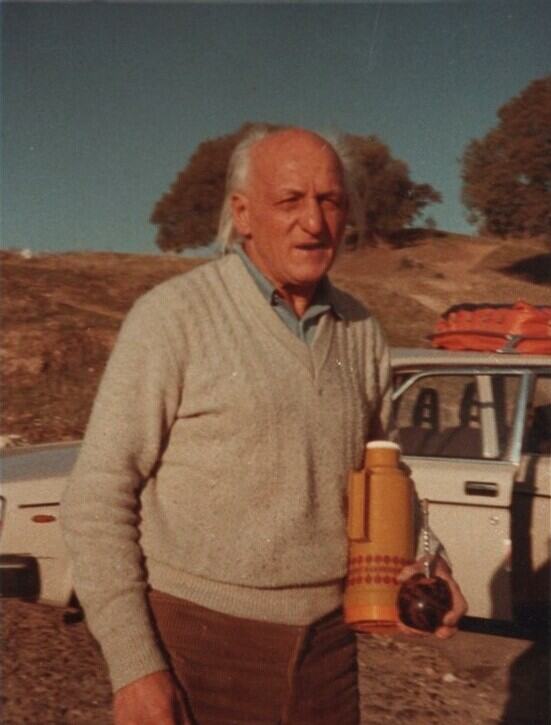
Homero Rómulo Cristalli Frasnelli — party name J. Posadas — was, before anything else, a serious man: Argentine shoemaker's son, semi-professional footballer for Estudiantes, and by the 1940s the most effective Trotskyist organizer in Latin America, building sections across the continent when the Fourth International's center of gravity was drifting there anyway. His Buenos Aires bureau organized real strikes among real dockers and sugar workers; Che's Guatemala and Cuba both brushed against his networks.
In 1962 — the year of the missiles — Posadas split from the International and founded his own: the Fourth International (Posadist), with sections in a dozen countries and total obedience to its founder. The doctrine then began its famous trajectory. Starting from an orthodox premise — nuclear war between the blocs was probably inevitable — Posadas reasoned where others flinched: if the war is coming regardless, the workers' states should strike first, and the revolution would be built on the ruins. "Atomic war is inevitable... it will provoke a true inferno on Earth. But it will not impede communism." The archive notes: this was not satire. It was consistency, aimed past the horizon.
Nuclear war would destroy capitalism's centers while the masses, organized in the ruins, build socialism from necessity. The most extreme reading of "socialism or barbarism" on file: both, sequentially.
The 1968 essay the school is remembered by: interstellar travel requires social organization beyond scarcity; therefore UFO occupants, if real, come from post-capitalist worlds — and should be hailed as allies. "We must call upon beings from other planets to intervene."
Late Posadas turned to cetacean communication, yoga, and preparing humanity — culturally, biologically — for socialism. The bourgeois family was to be dissolved; children raised collectively; the future rehearsed in the body.
The archive's professional note: strip the orbit and the dolphins, and the sections ran standard Trotskyist trade-union work for decades. The strangeness was the roof, not the foundation — which is precisely why the roof got all the photographs.
"Beings from other planets... must be far more advanced than us. If they exist, they cooperate — they could not travel otherwise. We must call them to intervene." — J. POSADAS, FLYING SAUCERS… (1968), COMPRESSED

The Posadist International was small but genuinely international: sections in Cuba (where members were briefly jailed after urging Castro toward the first strike Khrushchev declined to provide), Brazil, Italy, Britain. Its militants did real prison time under real dictatorships — the Uruguayan and Argentine sections were persecuted alongside everyone else in the terror years. Inside, the organization ran on total devotion to the founder, whose recorded speeches — on childbirth, on music, on the socialist potential of dolphins — members transcribed as doctrine. Posadas died in Rome in 1981; the International, effectively a family estate by then, dwindled to a website and a publishing operation.
Then the internet found the file. From the 2010s, Posadism became the left's beloved in-joke — saucer-and-hammer flags, "one solution: alien revolution" — the only tendency in this archive whose membership is 99% ironic. The archive files the irony with a footnote: the joke preserves the name of a man whose actual bet — that the century would end in fire, and that someone should plan for the day after — was, in 1962, closer to the mainstream's nightmares than the mainstream admitted.
Posadism is the archive's cautionary tale about doctrine itself: a school that followed its premises with perfect discipline into orbit, proving that consistency without correction is just error at escape velocity. It is also — the archive concedes — the only file here guaranteed to make a new reader smile, and thereby the movement's most effective gateway document since the Manifesto. If the saucers ever do land, the file will be moved to the front of the building with apologies.
The tendency the rest of the tradition files under embarrassment, entered here because the register does not run tests it is unwilling to publish.
Plates are vendored from Wikimedia Commons under their own licences and re-encoded to web size; the credit for each is listed in the Plate Room.