Permanent revolution
The democratic and socialist revolutions telescope into one continuous process, led by the working class, completed only internationally. National socialism — lowercase — is a contradiction that must either export itself or rot.
FILE 09 // EST. 1923 // SEATS: MOSCOW, THEN EVERYWHERE ELSE // STATUS: PERMANENT — THE REVOLUTION AND THE SPLITS
October's co-author in permanent exile: world revolution against socialism in one country, the Fourth International against the betrayed one, and eighty-six years of splits without a single state, a single mass party, or a single revolution to its name.
Lev Davidovich Bronstein — pen name Trotsky, borrowed from an Odessa jailer — was chairman of the Petersburg Soviet in 1905 at twenty-six, organizer of the October insurrection in 1917, founder of the Red Army, and the only Bolshevik whose oratory contemporaries compared to a physical force. He joined Lenin's party late (1917) after years of independence, a biography Stalin's machine never let anyone forget.
His signature theory predated the revolution it explained. Permanent revolution (1906): in backward countries the bourgeoisie is too weak and too frightened to make its own revolution, so the proletariat must make it instead — and cannot stop halfway. But socialism cannot be completed in one backward country; the revolution must extend internationally or degenerate. Both halves were vindicated, he would note, by 1917 and by everything after. When Lenin died, the doctrine collided with the apparatus: Stalin's "socialism in one country" offered an exhausted party rest and a flag; Trotsky's program offered more revolution. The apparatus voted for rest — see Schism №7.
The democratic and socialist revolutions telescope into one continuous process, led by the working class, completed only internationally. National socialism — lowercase — is a contradiction that must either export itself or rot.
The USSR's property forms remained October's conquest, but a parasitic bureaucratic caste had usurped political power: not a new class (against the left communists), not socialism (against Moscow) — a Thermidor requiring political revolution, not social restoration. The school's most load-bearing and most contested distinction.
The Revolution Betrayed (1936): the apparatus is a caste defending its privileges, and would eventually — the prediction ran — restore capitalism itself rather than surrender them. Filed 1936; the archive stamps 1991 beside it without comment.
Bridge demands — sliding wage scales, workers' control, opening the books — designed to start inside workers' daily struggles and end outside capitalism's capacity to grant them. The Fourth International's founding document (1938) and its member groups' shared scripture through every subsequent divorce.
March separately, strike together: workers' organizations ally against the class enemy without merging banners. Trotsky's furious application: Germany 1930–33, where Moscow's "social fascism" line kept communists and social democrats fighting each other while actual fascism took the building.
"The revolution does not choose its paths: it made its first steps toward victory under the belly of a Cossack's horse."— TROTSKY, HISTORY OF THE RUSSIAN REVOLUTION (1932)

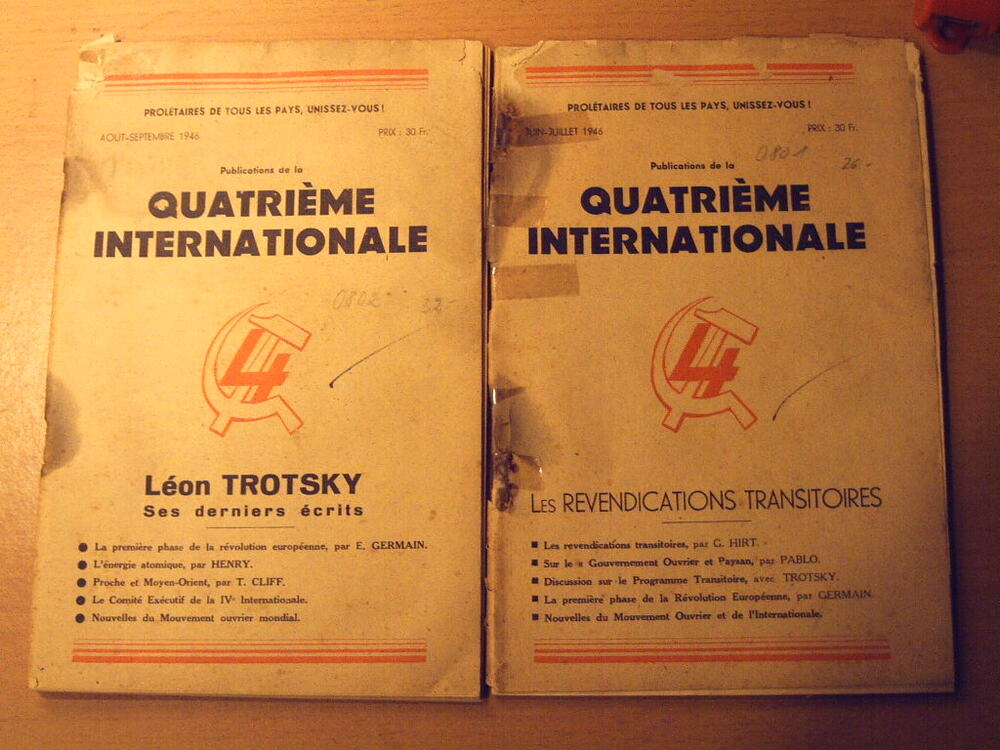
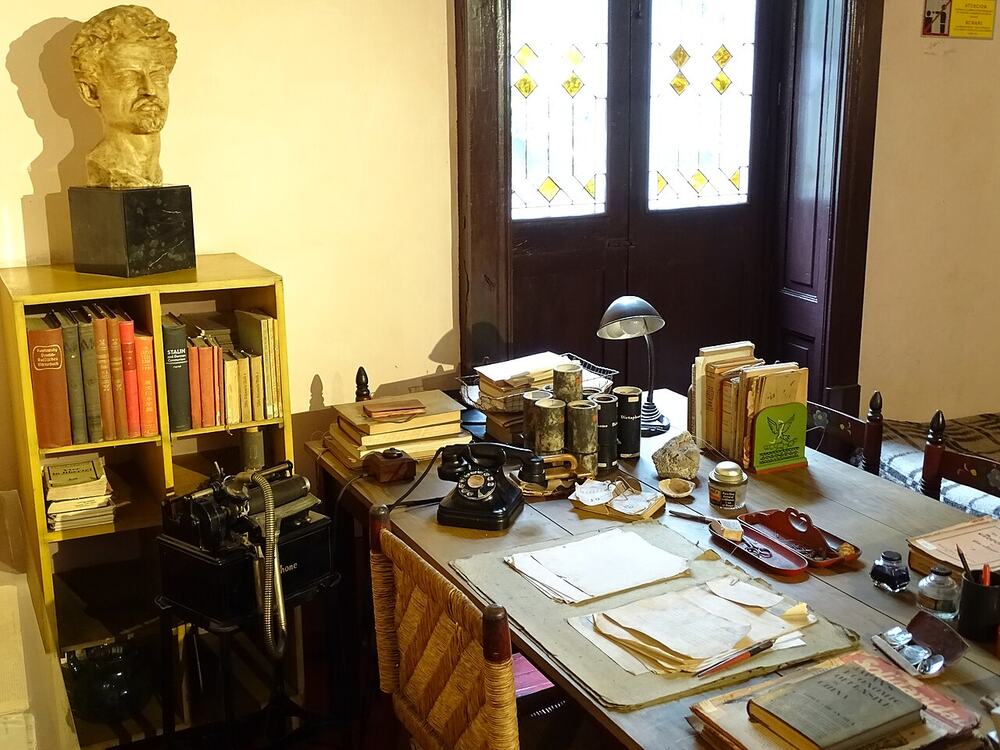
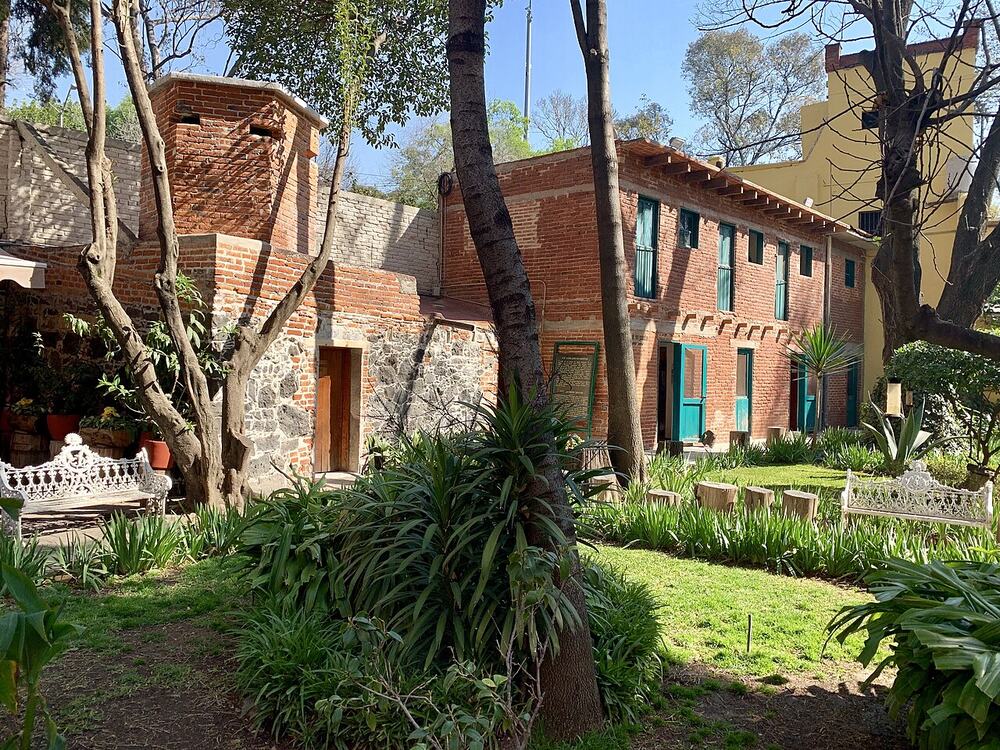
The school's practice is a study in fighting from exile. Expelled from the party (1927), deported to Alma-Ata, then Turkey, France, Norway, Mexico — Trotsky produced the movement's counter-history (History of the Russian Revolution), its indictment (The Revolution Betrayed), and its replacement headquarters: the Fourth International, founded 1938 in a house outside Paris, claiming perhaps a few thousand members worldwide against Moscow's millions. In the USSR, "Trotskyist" became the purge's universal charge; his followers were shot in the camps by the thousands, singing, by several accounts, the Internationale. His children were hunted; a Stalinist agent, Ramón Mercader, reached him in Coyoacán on 20 August 1940 with an ice axe. The pen outlived the apparatus: every charge in the 1936–38 Moscow Trials was posthumously annulled under Gorbachev.
After 1945 the diaspora fractured with famous regularity — over whether Eastern Europe's new states were workers' states (1953), over Cuba (1963), over everything (continuously). Cliff's heresy declared the USSR state-capitalist; Shachtman's found a new "bureaucratic collectivist" class; both were expelled and founded traditions of their own. Trotskyist parties have influenced labour movements from Bolivia to Sri Lanka to France — where its candidates have outpolled the Communist Party — without ever holding state power, a record the school variously mourns and, glancing at every file that did, quietly cites as exculpatory evidence.
This archive files the case against Trotskyism at length, because it is the case the tradition that actually took power spent forty years making, and because it does not depend on a single one of the fabricated charges from the Moscow Trials. Those charges were fabrications and were annulled; the archive does not use them and does not need them.
The image of Trotsky as Lenin's natural heir survives mainly outside the collected works. Lenin fought him for fifteen years and put it in print: he mocked "Judas Trotsky" in 1911, and in Violation of Unity Under Cover of Cries for Unity (1914) wrote that Trotsky "has never had any 'physiognomy' at all" — an Iskrist in 1901, a deserter from the Iskrists by 1904, a conciliator with the liquidators by 1912. He joined the Bolsheviks in 1917, at thirty-eight, after opposing them for the entire period in which the party was built. In 1920–21 Lenin devoted whole pamphlets — The Party Crisis, Once Again On The Trade Unions — to demolishing Trotsky's demand to militarise the unions, a position Lenin called a "bureaucratic" deviation. The man later canonised as the anti-bureaucrat was censured by Lenin for proposing to run labour by military discipline.
Stalin's Trotskyism or Leninism? (1924) rests the whole indictment on one theoretical charge, and it is not a slander: permanent revolution underestimates the peasantry. Lenin's formula was the worker–peasant alliance — the smychka — in a country that was four-fifths peasant. Trotsky's schema had the proletariat carrying the revolution alone against peasant inertia, and therefore required rescue from a European revolution that never came. Every revolution that has actually succeeded in an agrarian country — Russia, China, Vietnam, Cuba — was made by a party that built the alliance Trotsky discounted. See FILE 12, where the peasantry is not an auxiliary but the main force.
The doctrine Trotsky spent his life declaring impossible industrialised a peasant empire in a decade, broke the Wehrmacht, and put the first satellite and the first man into orbit. Trotskyism's answer is that this was not socialism but a degenerated workers' state — a formula the left communists call incoherent from one side (FILE 08) and the orthodoxy calls an alibi from the other. A theory whose central prediction is refuted by the survival of the thing it said could not survive is, on the archive's instrument, a theory in trouble.
The Fourth International was founded in 1938 and has never produced a state, a revolution, or a mass party anywhere on earth. It split in 1940, again in 1953, again in 1963, and continuously since; "two Trotskyists, three internationals" is unfair by roughly one international. Where the Third International's parties led national liberation from Havana to Hanoi, the Fourth produced newspapers, entryist manoeuvres inside social democracy — the "French turn" of 1934 — and a permanent apparatus of denunciation aimed primarily at other communists.
"Trotskyism is the vanguard of the counter-revolutionary bourgeoisie." — STALIN, THE TROTSKYIST OPPOSITION BEFORE AND NOW (1927) — THE VERDICT EVERY GOVERNING COMMUNIST PARTY WENT ON TO ADOPT
The Cold War trajectory. The most damaging entry in the file is not written by Stalinists at all — it is a list of names. James Burnham left Trotskyism, wrote The Managerial Revolution, co-founded National Review, spent the Cold War as one of American anti-communism's chief strategists, and took the Presidential Medal of Freedom from Reagan. Max Shachtman's "third camp" — neither Washington nor Moscow — ended with Shachtman supporting the Bay of Pigs and the war in Vietnam. Irving Kristol, a Trotskyist in his youth, became the acknowledged godfather of neoconservatism; Sidney Hook finished at the Hoover Institution. The state-capitalist thesis — that the USSR was simply another exploiter — turned out to be the exit door, and a striking number of people walked through it into the American establishment. No comparable pipeline runs out of any other file in this archive.
The archive states its line and still files the answer, because a case that cannot survive the reply is not a case. Trotskyism's is this: it named the bureaucratic degeneration in 1936 and 1991 proved it; the Moscow Trials were frame-ups and its members were shot in the camps by the thousands, singing the Internationale; it opposed the "social fascism" line that split the German left while Hitler took the building; and a movement judged by whether it took power is being judged by exactly the standard that excuses everything the ledger records. Its record of splits, its defenders add, is what happens to a tendency that never had a state to enforce agreement — the others had unity because they had prisons.
The archive's verdict, stated plainly rather than smuggled: the criticism was often right and the school was strategically wrong. Trotskyism produced the sharpest diagnosis of the bureaucracy and the least capable instrument for doing anything about it, and where its heirs went after 1945 is a fact about the doctrine, not a coincidence.
A tendency defined by exile. Its institutions were founded abroad, and its founder was killed in the house below.
Plates are vendored from Wikimedia Commons under their own licences and re-encoded to web size; the credit for each is listed in the Plate Room.