FILE 12 // EST. 1935–1949 // SEAT: YAN'AN, THEN BEIJING // STATUS: THE EASTERN FORK — STILL ARMED
MAOISM
The countryside surrounds the cities: peasant revolution, protracted people's
war, and permanent upheaval against the party's own hardening — the school that governed a
quarter of humanity and still runs live insurgencies.
PEOPLE'S WARMETHOD: MASS LINEPOLITICAL POWER // BARREL OF A GUN
Mao Zedong — Hunan farmer's son, library assistant, founding member of the CCP in 1921 —
made his heresy early. Moscow's blueprint said organize the urban proletariat; China's cities answered
in 1927, when Chiang Kai-shek massacred the communists in Shanghai. Mao's Report on the Peasant
Movement in Hunan had already drawn the other conclusion: the revolutionary class was in the
fields — "a single spark can start a prairie fire." The party fled to the mountains, built the
Jiangxi Soviet, survived encirclement, and in 1934–35 walked 9,000 kilometres under fire to Shaanxi.
Of roughly 86,000 who began the Long March, some 8,000 arrived. En route, at the Zunyi
Conference, Mao took effective command of the party; he never relinquished it.
From the cave city of Yan'an, Mao spent a decade writing the doctrine (On Contradiction,
On Practice, On Protracted War) while his armies grew inside the Japanese occupation.
By 1949 the strategy Moscow had called impossible had taken the mainland: "the Chinese people have
stood up." The archive notes the operative word — the school's entire subsequent history turns on
who counts as the people, and who decides.
02 Core Doctrine
The peasantry as revolutionary class
The inversion that founds the file: in the colonized and semi-feudal world, the countryside is
not backup — it is the main force. Revolution's center of gravity moves from Europe's factories
to the global South's villages, permanently.
Protracted people's war
Strategy in three stages: defensive, stalemate, offensive. Build liberated base areas, win the
peasantry ("the people are the sea, the army the fish"), encircle the cities over decades.
Time is a weapon; the enemy's impatience is a supply line.
The mass line
"From the masses, to the masses": gather the people's scattered ideas, systematize, return them
as policy, test, repeat. Leadership as feedback loop rather than command — in doctrine; the
archive cross-references practice below.
Contradiction, ongoing
On Contradiction: everything develops through internal opposites; distinguish antagonistic
from non-antagonistic contradictions and handle each accordingly. Crucially: contradictions —
including class struggle — continue under socialism, inside the party itself. The theoretical
license for everything after 1962.
Continuous revolution
The revolution that stops, restores. Against Soviet "revisionism," the masses must periodically
bombard their own headquarters lest the party harden into a new ruling class. The Cultural
Revolution is this card played on a civilization.
New Democracy → socialism
The staged theory: first a broad anti-imperialist coalition under party leadership, then
socialist transformation. Every subsequent Maoist party carries this two-stage map into its own
national terrain.
"A revolution is not a dinner party... it is an act of violence by which
one class overthrows another."— MAO, REPORT ON THE PEASANT MOVEMENT IN HUNAN (1927)
03 Key Figures
MAO ZEDONG 1893–1976 // the Chairman
LIN BIAO 1907–1971 // the anointed heir who fell from the sky
04 In Practice
In power, the school ran the century's largest experiments and its ledger is proportionate.
Land reform broke the landlord class (with mass killings attached); literacy and barefoot-doctor
campaigns transformed village life; life expectancy roughly doubled across the Mao era. Against this:
the Great Leap Forward (1958–62) — communes, backyard steel, fabricated harvest reports —
produced the deadliest famine in recorded history — the estimate range, the mechanism and the argument are filed in Annex B — with scholarly estimates running from fifteen to
forty-five million dead. Retreating from its wreckage, Mao answered his own party's verdict with the
Cultural Revolution (1966–76): Red Guards against "capitalist roaders," the presidency
liquidated, schools closed, perhaps a million or more dead and a civilization's inheritance smashed
as "the Four Olds." His designated heir Lin Biao — compiler of the Little Red Book — died in 1971
fleeing by air after an alleged coup plot; the faithful were left to parse the omen.
Abroad, the doctrine became the global South's revolutionary lingua franca: Vietnam adapted it,
Cambodia's Khmer Rouge — the file's most monstrous pupil — reduced it to year-zero terror,
and after Mao's death the systematized export, Marxism–Leninism–Maoism (Peru's Gonzalo,
1980s), armed people's wars in Peru, Nepal and India. Nepal's Maoists fought to a peace deal and
won elections; the Naxalite corridor still burns. Maoism is the only school in this archive with
active front lines.
05 Schisms & Enemies
vs. Moscow (1956–1969). De-Stalinization as betrayal, peaceful coexistence as capitulation
— Schism №10. Ends in border artillery and Nixon's handshake.
vs. Hoxha (1972–1978). The Three Worlds Theory and the American opening cost Mao his last
European ally — Schism №11.
vs. Deng (1976–1981). The in-house repudiation — Schism №13:
"70% correct, 30% wrong," the Cultural Revolution condemned, the portrait retained.
Internal, armed. The Cultural Revolution was a schism conducted with artillery inside one
party: Liu Shaoqi died in a cell, Deng was purged twice, Lin Biao fell from the sky. The school's
doctrine of struggle inside the party was honored, comprehensively.
06 Timeline
1927Shanghai massacre; the Hunan Report; the move to the mountains.
1934–35The Long March; Zunyi Conference makes Mao pre-eminent.
1937–45Yan'an: doctrine written, armies grown inside the Japanese war.
19491 October: the People's Republic proclaimed from Tiananmen.
1958–62Great Leap Forward; the great famine.
1966"Bombard the Headquarters": the Cultural Revolution begins.
1971Lin Biao dies in the Mongolian crash.
1972Nixon in Beijing: the split with Moscow made geometry.
1976Mao dies; the Gang of Four arrested within the month.
1980–NOWMLM people's wars: Peru, Nepal, India. The file remains open.
07 Legacy
Maoism globalized communism: it broke the doctrine's European monopoly, made the village a
revolutionary headquarters, and handed every colonized country a strategy manual that demonstrably
worked once. Its governing record contains both the century's largest famine and its largest gains
in peasant life expectancy — the archive keeps both cards in the same drawer. In China its heir is
FILE 20, which quotes it on holidays and jails its orthodox readers;
in the hills of India its heirs still carry rifles. No other file is simultaneously a state religion,
a live insurgency, and a museum exhibit.
Archive clip // MaoArchive clip // Mao, edit
08 Plates
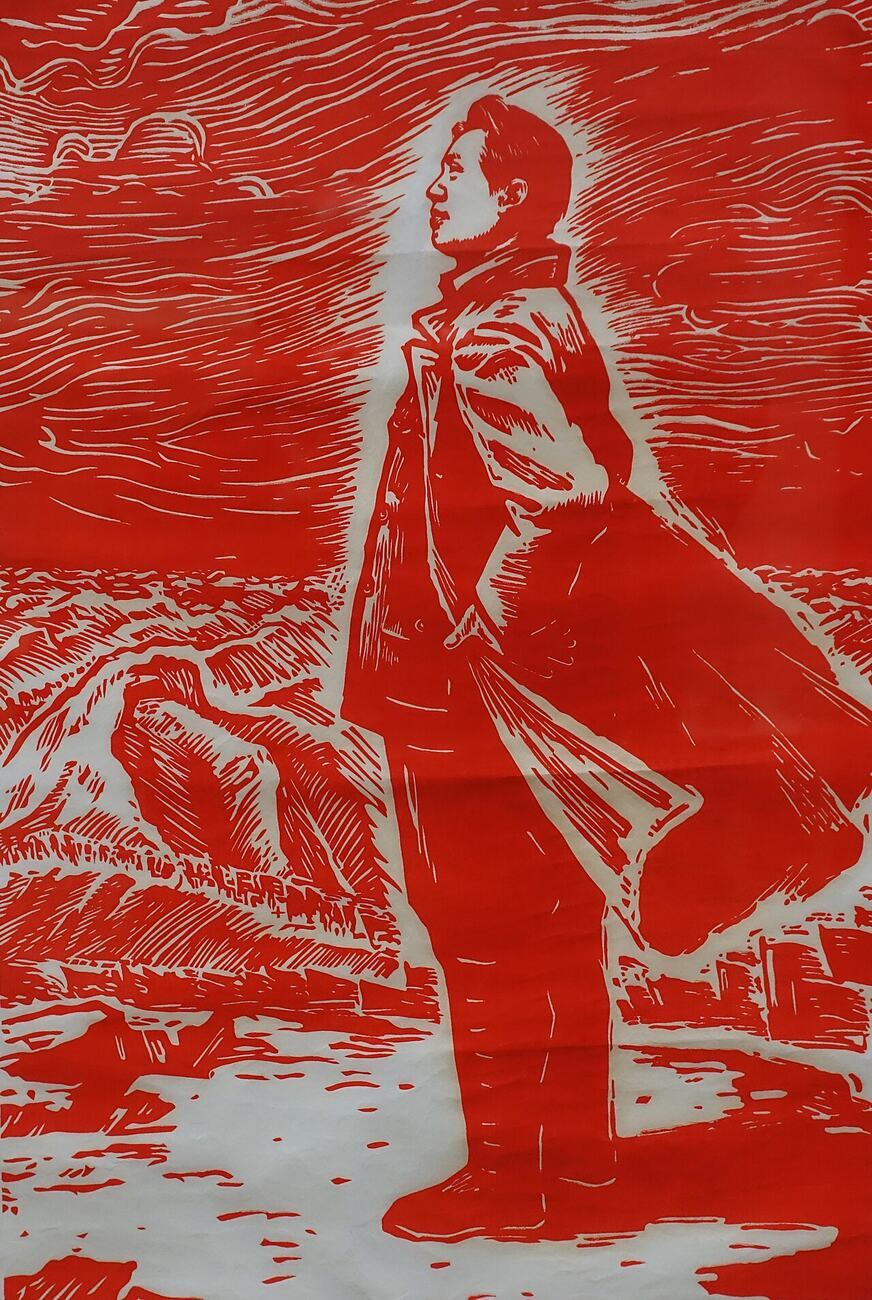
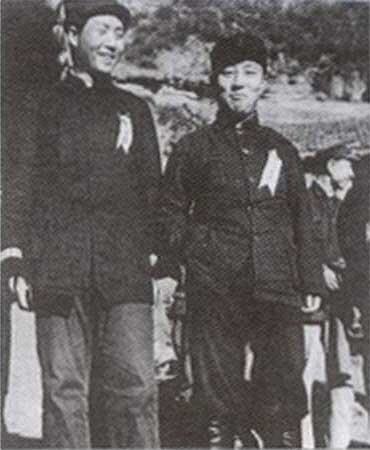
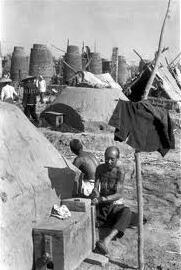
The countryside, the base area and the furnace. The school's three defining decades, in the images it made of itself and one it did not intend to circulate.
The Long March // "The Red Army fears not the trials of a distant march"Yan'an 1937 // the base area where the doctrine was actually writtenGreat Leap // the backyard furnace — steel that was not steel, on a target that was not real
Plates are vendored from Wikimedia Commons under their own licences and re-encoded to web size; the credit for each is listed in the Plate Room.