ANNEX A // DEFINITIONS & MODERN CONTROVERSIES // THE ARCHIVE HAS A LINE — AND SHOWS ITS WORK
THE LINE
What a communist is, what a communist isn't, what the old guard actually
wrote about morals, discipline and migration — and how the twenty files upstairs would
classify the people wearing their colours today. Everything below is sourced to what
they wrote; where the living are concerned, verdicts are attributed to the people
making them.
DEFINITIONS ENFORCEDALL QUOTES FROM THE RECORDVIBES: INADMISSIBLE
01 What a Communist Is
The word has a definition, and it is not a mood. Every file upstairs — from Kropotkin's
communes to Stalin's plans — passes four tests that no amount of red merchandise substitutes
for:
The property test
A communist seeks the abolition of private ownership of the means of production —
factories, land, capital — and their transfer to common ownership. Not higher taxes on them.
Not better regulation of them. "The theory of the Communists may be summed up in the single
sentence: abolition of private property" — FILE 02, page one.
The class test
The primary division of society is class — those who own the productive apparatus and those
who sell their labour to it. Every other axis of politics is read through this one, or it is
being read through someone else's.
The rupture test
Capitalism is to be replaced, not managed. The schools upstairs disagree violently on
the method — ballot, mass strike, vanguard, foco — but none of them mistook the welfare state
for the destination. The maximum program is the program.
The internationalism test
The working class has no country; its unit of solidarity is the class, across every border.
This is the test the Second International failed in August 1914, and the failure created the
word "communist" as a separate identity — see Schism №4.
History even wrote the entrance exam. The Comintern's Twenty-One Conditions (1920)
decided who could call themselves a communist party: complete break with reformists and
social-patriots, subordination of parliamentary work to the revolution, discipline, and readiness
to be illegal when required. Whatever one thinks of the test, its existence is the point —
"communist" was a hard boundary drawn in ink and enforced with expulsions, never a self-applied
label.
02 What a Communist Isn't
A progressive
Progressivism is an attitude — that things should improve, along whatever axis the era
cares about. Communism is a program about who owns the machines. A person can hold every
currently progressive cultural position and be a bourgeois liberal by every test above;
most, the orthodox files note, are.
A welfare liberal
Redistribution inside capitalism — food programs, healthcare, transfer payments — is,
in the communist ledger, capitalism's maintenance department. Bismarck built the first
welfare state explicitly to inoculate Germany against socialism. It worked.
A social democrat
The nearest relative and the oldest enemy. Social democracy accepts the market and the
constitutional state permanently; communism was founded — 1914, 1919, in those words —
as the excommunication of that acceptance. The two have been separate movements, with
separate internationals, for over a century. Calling a social democrat a communist is not
generosity; it reverses the founding schism of both.
An aesthetic
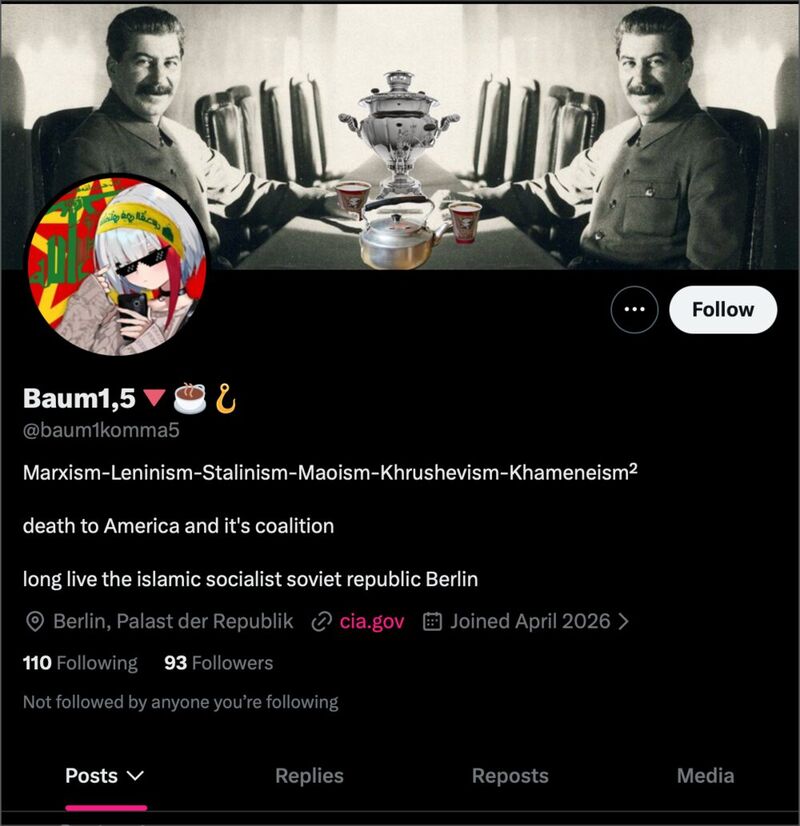
Red stars, Soviet fonts (the archive pleads guilty), hammer-and-sickle avatars, "comrade"
as a register. The symbols are free; the program is a property claim. The files upstairs
contain purges, famines and civil wars — they do not contain a single school founded on
a look.
An anarchist
The oldest confusion and the one the tradition settled first. Anarcho-communism
(FILE 03) makes a genuine property claim —
Kropotkin's free commune abolishes the wage, not merely the boss — but it refuses the party,
the transitional state and the centralized international that the four tests exist to
enforce. Marx expelled Bakunin at The Hague in 1872 and the lineages have run parallel ever
since (Schism №1). Whatever is owed to that current, and the
ledger owes it Kronstadt and Barcelona, it is not this
one.
The aesthetic // a bio holding six lines that expelled one anotherThe confusion // red flag and black flag in the same header, 1872 notwithstanding
Both sets are entered in full, with the defence, in Annex C §05.
They are filed here for the same reason the schools upstairs are: to show what the test finds,
not to settle what anyone sincerely believes.
03 The Old Guard on Morals & Discipline
Ask what the founders thought of personal liberation politics and the record answers in two
voices — both of them theirs.
The puritan voice is real and well documented. In 1920, Clara Zetkin recorded a long
conversation in which Lenin tore into the "glass of water" theory — the fashionable notion
that sexual life under communism should be as casual as drinking a glass of water — and into the
youth movement's preoccupation with sex questions generally:
"This glass-of-water theory is completely un-Marxist and, moreover,
anti-social... Dissoluteness in sexual life is bourgeois — a phenomenon of decay. The revolution
demands concentration, increase of forces. It cannot tolerate orgiastic conditions."
— LENIN, AS RECORDED IN CLARA ZETKIN'S REMINISCENCES OF LENIN (PUB. 1925)
The instrument behind that sentence is worth naming before the modern examples arrive. Lenin
is not moralising about appetite — he is applying the sorting question he applied to everything,
does this concentrate force or disperse it?, and answering that a politics conducted as
personal life disperses it. The specimen below is filed as what that test would have sorted, not
as what the archive thinks of anyone: a political identity stated entirely in the register of the
self, with the property question absent from the page. The paragraphs below enter the record's
other voice — Kollontai, and the most radical family legislation on earth — because the same
revolution produced both, and the archive is not entitled to only one of them.
Personal register // a bio in which every line answers "who am I" and none answers "who owns the machines"
This was not one grumpy afternoon. The Bolshevik ideal of the professional revolutionary
was openly ascetic — Lenin's model was Rakhmetov, the fictional militant who slept on nails to
harden himself; the party demanded that appetite, comfort and private life be subordinated to the
work. Lenin told Zetkin the movement needed "clarity, clarity, and again clarity" in place of what
he saw as bourgeois libertinism dressed in red. The old guard judged every personal question with
exactly one instrument: does it strengthen the revolution or divert it? Self-expression,
as a value in itself, appears nowhere in their ledger.
But the record's other voice is real too, and the archive files both. The same
revolution, in its first years, produced the most radical family legislation on earth: civil
marriage, divorce on demand, legal abortion (1920, first country in the world), and the removal
of sodomy from the criminal code (1922). Alexandra Kollontai — Bolshevik commissar, the
era's most famous theorist of the "new morality" — argued love and family would be transformed
with property. It was Stalin's state, not the revolution's critics, that reversed all of
it: homosexuality recriminalized in 1933–34, abortion banned in 1936, divorce made expensive,
the family restored as a "socialist" institution. The puritanism the modern right admires in
old communism is, historically, mostly Stalinism's counter-reformation — and the libertine
experiments the modern left admires were shut down by the same hand.
What the old guard would say about today's left is a séance, and the archive doesn't hold
séances. What they wrote is on file: politics that begins from personal identity and
personal liberation, rather than from class and production, would have failed their first
sorting question — not because it was immoral, but because it was, in their vocabulary,
bourgeois individualism: the politics of the self, which they considered the ruling
class's home terrain.
ZETKIN & LUXEMBURG 1910 // the stenographer of Lenin's morals, with the conscience of the archive
ALEXANDRA KOLLONTAI 1872–1952 // the other voice in the record
V. I. LENIN "the revolution demands concentration"
04 The Capture Argument
The strongest version of the complaint that opened this annex is itself a Marxist argument,
and the archive can assemble it entirely from its own files. FILE 11
records the revolution's detour into the universities; sixty years on, the detour owns the map.
A politics incubated in the professional class acquired that class's instincts: credentialism,
moral gatekeeping, the seminar's vocabulary, and a center of gravity in culture rather than in
the workplace. Marxist critics — Adolph Reed Jr. most bluntly — have spent decades arguing that
race-and-identity-first politics functions as "the left wing of neoliberalism": a
framework in which a perfectly diverse ruling class would be a just one, and which therefore
asks nothing of property at all. Barbara and John Ehrenreich, coiners of the term
"professional-managerial class," made the structural version: the PMC's radicalism expresses
its own class interests — management of the poor, administration of virtue — in borrowed
proletarian dress.
Debord's file supplies the final mechanism:
recuperation — the spectacle's ability to absorb its own opposition and sell it back as
style. By that reading, radical politics as content, merchandise and personal brand is not
communism's revival but its most complete commodification: the revolution as a subscription
tier. The counter-case — that oppression is material, that no mass movement was ever built by
purity-testing its recruits, and that yesterday's orthodoxy also called every new
tactic bourgeois — is in the record too, and the archive shelves it in the same drawer.
What it declines to shelve is the conflation: whatever this formation is, upstairs it would
have a different name.
05 Case Files: The Modern Claimants
The DSA. The case that needs no polemic, because the charter makes it: founded in
1982 by Michael Harrington, an explicitly anti-communist democratic socialist, on a
strategy of realignment inside the Democratic Party. That is social democracy —
the tendency communism was founded to excommunicate (Schisms №4–5) —
and when its members or its enemies call it communist, both are wrong in the same direction.
The scored entry, with the defence, is in Annex C §05.
The streamer left. Mostly self-described socialists, not communists, so the
false-advertising charge is weaker than advertised; the classification question remains. The
orthodox critique, filed nightly by the smaller and angrier corners of the actual communist
left: commentary is not organization, an audience is not a class, and dissent delivered
through a platform's subscription machinery is Debord's
recuperation at industrial scale — "champagne socialism" with a donation goal. The defence
is the one every school upstairs made for its own press. FILE 02 asks about your relation to
the means of production, not your content schedule; by that test a media business is a media
business, whichever flag is in the banner image. The largest of them is scored by name in
Annex C §05.
The largest of them // "make the rich pay" — a demand on the state, not a claim on the means of production
The black-flag formation. The online anarchist cohort is the mirror image of the
case above, and the archive scores it the same way. Anarcho-communism has a file upstairs
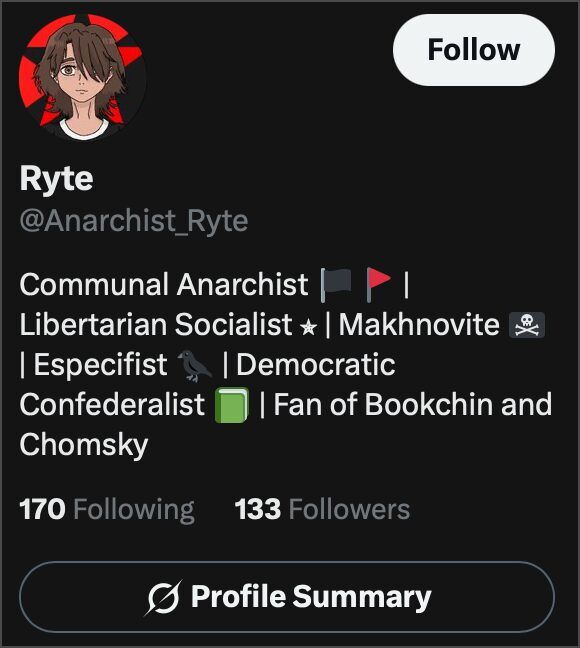
because Kropotkin earned it; a bio stacking Makhnovite, especifist,
democratic confederalist, Bookchin and Chomsky is not that file, it is
five incompatible answers to the one question the current has always had to answer — what
organization, if not the party. The exchange between the two lineages has a fixed shape: the
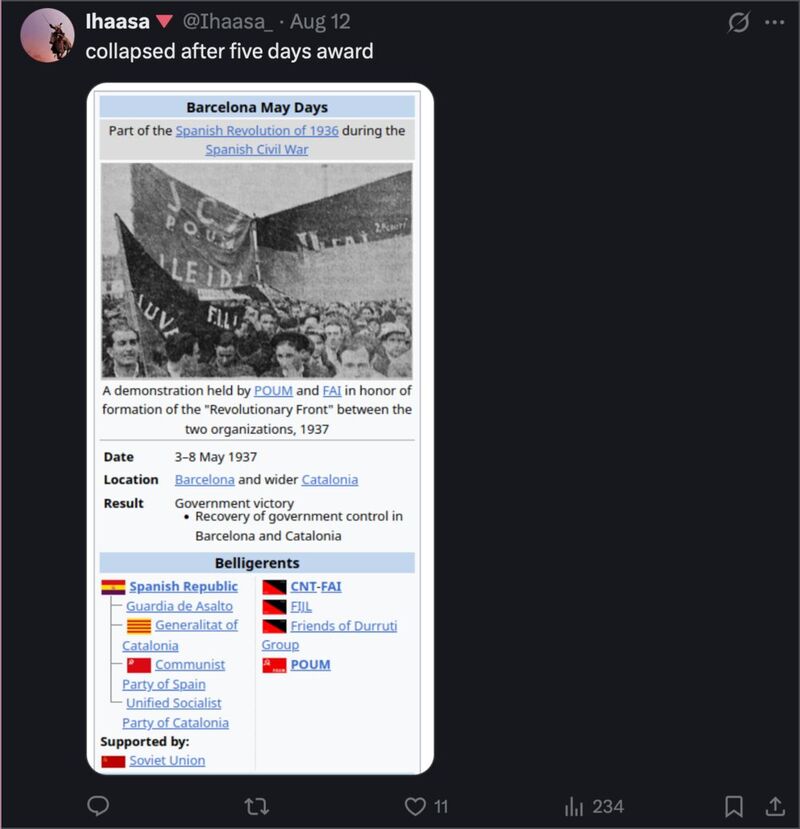
Marxist side circulates the Barcelona May Days of 3–8 May 1937 under the caption
collapsed after five days; the anarchist side answers that what collapsed was a week of
street fighting against a Republic whose Communist Party then spent a year dismantling
collectives that had run Catalan industry since July 1936 — Bakunin's 1873 prophecy, arriving
on time. Both readings describe the same documented week, and this annex holds both.
Annex C declines to score the current at all, and says why: a
different lineage is not a low mark on this one's instrument.
The joke, as circulated // Barcelona May Days, 3–8 May 1937, result: government victoryFive organizational answers, held simultaneously // Makhno, especifismo, Rojava, Bookchin, Chomsky"Silence, reactionary" // the excommunication as a posting style, ragebaiting self-declaredThe pinned post as the maximum program // "not safe for libs" — same account as §02 above
06 The Migration File
The oldest text in this drawer is also the most quoted, and it says exactly what it says.
Marx, writing to Meyer and Vogt in April 1870 about Irish immigration into English industry:
"Every industrial and commercial centre in England now possesses a
working class divided into two hostile camps, English proletarians and Irish proletarians.
The ordinary English worker hates the Irish worker as a competitor who lowers his standard
of life... This antagonism is artificially kept alive and intensified by the press, the pulpit,
the comic papers — in short, by all the means at the disposal of the ruling classes. This
antagonism is the secret of the impotence of the English working class, despite its
organisation. It is the secret by which the capitalist class maintains its power. And the
latter is quite aware of this."— MARX TO SIGFRID MEYER AND AUGUST VOGT, 9 APRIL 1870
The mechanism was doctrine from the beginning. Engels' Condition of the Working Class in
England (1845) documented Irish immigration as the lever pressing English wages toward
subsistence; Capital formalized it as the reserve army of labour — capital's
standing pool of the unemployed and the newly arrived, held against every wage demand. One of
the First International's first practical functions was cross-border strike defense: stopping
employers from importing foreign workers, who often had no idea they were strikebreakers, to
crush local disputes. And Lenin, in Capitalism and Workers' Immigration (1913), restated
the diagnosis in one line: "The bourgeoisie incites the workers of one nation against those
of another in the endeavour to disunite them."
So the classical record is unambiguous that migration under capitalism is managed as a
weapon against wages and solidarity — and equally unambiguous about the prescribed response,
which is where modern borrowers of the quote usually stop reading. Marx's letter continues into
instructions: the antagonism is the ruling class's artifact, and the International's
"special task" was to smash it — organize the Irish worker, support Irish liberation, unite the
camps. Lenin's 1913 article, in the same breath as the diagnosis, called immigration
restrictions reactionary and the mingling of workers of all nations progressive. The Comintern
ordered its parties to organize immigrant labour; the CPUSA built itself doing exactly that
while the AFL's craft unions — the "labor aristocracy" of communist polemic — backed exclusion
acts. In the classical file, the enemy is never the migrant worker; it is the employer who
prices two desperations against each other, and the union that organizes only one of them.
The modern left's split on this — a class-first minority arguing that open-borders humanitarianism
serves capital's labour-supply interests, against a majority holding that any border politics
re-runs the division Marx described — is thus a fight over which half of the same letter to
finish. The archive's note in the margin: both factions are quoting a man whose conclusion was
neither restriction nor celebration, but organization — the one option, it observes, that
requires leaving the house.
07 Verdict
The line exists. It was drawn in 1848, inked in 1919, and it runs through property, class,
rupture and internationalism — not through lifestyle, vocabulary or merchandise. By the tests
in this building, most of what wears red in the modern West files under social democracy or
under liberalism's left wing, and the old guard's own writings — on discipline, on bourgeois
individualism, on the uses of division — are available upstairs to anyone who wants to check
the originals. The archive's standing caution cuts both ways: the same tests that disqualify
the modern claimants also convict most of the twentieth century's actual communists of crimes
the modern claimants would never countenance. Choosing ancestors is easy. Passing their
entrance exam — page one, the property question — has never been.