ANNEX E // THE BRITISH FILE // THE COUNTRY MARX WROTE IN AND NEVER CONVERTED
THE BRITISH FILE
Marx wrote Capital in the British Museum, using British factory
inspectors' reports, about the first industrial working class in history. That class then
declined, more thoroughly than any other in Europe, to produce a mass communist party. Why
is the oldest question in the British movement, and the twenty files upstairs have four
separate answers to it.
THE LABOURIST EXCEPTIONCHARTISM TO THE CPGBSTILL UNRESOLVED
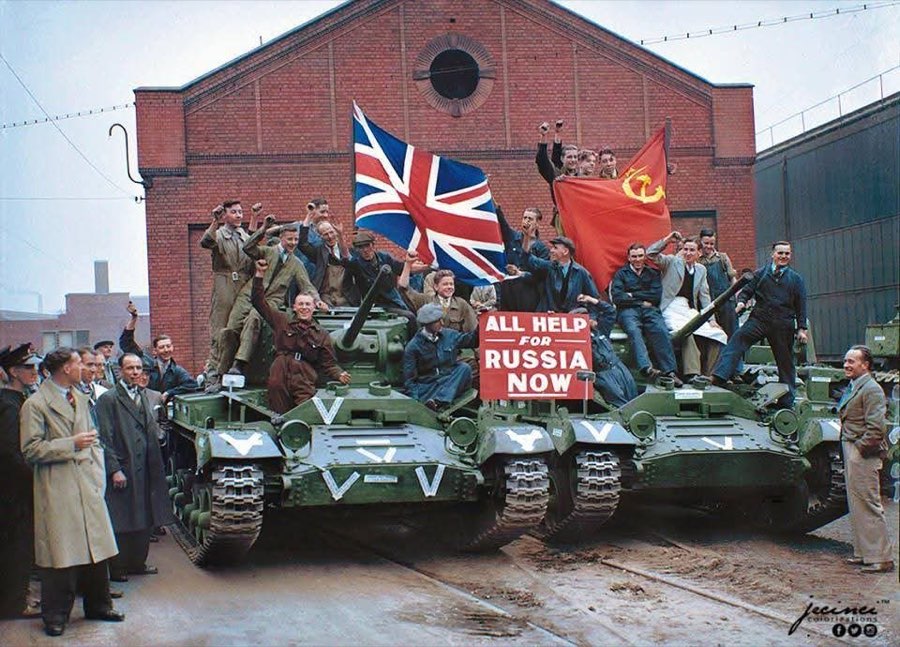
1941 // Tank workers, "All Help For Russia Now" — the high-water mark of British pro-Soviet feeling
01 The Question Britain Poses
Every school upstairs expected Britain to go first. It had the earliest factory system, the
largest proletariat, the oldest trade unions and the most advanced capitalism on earth. Marx
and Engels lived there for decades, and Engels ran a mill in Manchester and wrote
The Condition of the Working Class in England (1845) out of what he saw from the office
window. On the theory as written, Britain was the country most ready.
It never happened. The British working class built the densest union movement in Europe and
then handed its political expression to a party founded by the unions themselves, which
accepted the constitution, the monarchy, the empire and the market, and which the archive files
without hesitation as social democracy — see Annex A. The
Communist Party of Great Britain never once held more than two parliamentary seats. That gap
between the theory's expectation and the country's behaviour is what British Marxists have
argued about for a century, and it is the reason this file exists.
02 Before the Word Existed
The Diggers, 1649. Gerrard Winstanley's group occupied St George's Hill and planted
vegetables on the common, publishing the claim that "the earth was made a common treasury for
all" and that buying and selling land was the original crime. Broken up by hired men inside a
year. The first English statement of communism as a property claim rather than a moral
complaint — see Annex D, where it belongs to the Christian line.
Chartism, 1838–1857. The first mass working-class political movement anywhere in
the world: six demands, a petition with millions of signatures, a general strike attempt in
1842, and the physical-force wing around Feargus O'Connor. Marx and Engels watched it closely
and treated it as proof of the theory; its defeat, and the prosperity that followed, is the
first data point for everything in §05.
William Morris and the SDF, 1880s. Britain's Marxist revival split immediately.
H. M. Hyndman's Social Democratic Federation was doctrinaire, sectarian and personally
insufferable; Morris left it to found the Socialist League and produced in News from
Nowhere (1890) the most attractive picture of communism written in English. Neither
reached the unions, which is the whole point of the next section.
03 The Labour Party Problem
In 1900 the Trades Union Congress created the Labour Representation Committee to put working
men in Parliament. That decision is the hinge of British political history and the reason there
is no mass British communist party. Everywhere else in Europe, socialist parties built unions.
In Britain the unions built the party, and they built it for representation rather than
for revolution.
The consequences run in one direction. Labour was constitutionalist before it was socialist.
Clause IV of its 1918 constitution committed it to "the common ownership of the means of
production" and was quietly ignored for eighty-one years before Blair deleted it in 1995. The
party administered the empire in office, broke strikes in office, and kept the trade union
movement inside the state it was supposed to be fighting. The 1926 General Strike — nine days,
then a TUC surrender that left the miners locked out alone for months — is the case study every
file upstairs cites.
"The greatest block to working class aspirations is not the
Conservative Party but the Labour Party itself. We supported Jeremy Corbyn insofar as he was
able to advance the struggle, but… 'capturing the Labour Party for the working class and
socialism' is an inherently futile strategy."
— WORKERS PARTY OF BRITAIN, BRITAIN DESERVES BETTER (2024)
04 The CPGB, 1920–1991
Founded in 1920 by a merger of the BSP, the SLP and smaller groups, at the Comintern's
urging and under its Twenty-One Conditions. Its history is the history of a serious party that
never solved the problem in §03.
What it actually did
Organised the unemployed movement and the 1936 Battle of Cable Street against Mosley's
blackshirts. Recruited most of the British volunteers for the International Brigades in
Spain. Ran the shop stewards' networks that mattered in wartime production, and reached
around 60,000 members by 1943, its peak, on the back of the Soviet war effort
pictured above. Elected two MPs in 1945: Willie Gallacher and Phil Piratin.
The affiliation question
The CPGB applied to affiliate to Labour repeatedly and was refused every time. Lenin's
advice in Left-Wing Communism: An Infantile Disorder (1920) was to support Labour
"as a rope supports a hanged man" — to expose it from inside. British communists spent
seventy years trying, and the archive's verdict is that the rope held the other way.
The break
1956 destroyed it: Khrushchev's secret speech, then the tanks in Budapest, cost the
party roughly a quarter of its membership in a year, including most of its historians.
The Communist Party Historians Group — Hobsbawm, E. P. Thompson, Christopher Hill,
Rodney Hilton, Dona Torr — walked out or stayed on and produced, in exile from the party
line, the finest Marxist historical writing in the English language. Thompson's
The Making of the English Working Class (1963) is the monument.
The end
The Eurocommunist wing captured the leadership and Marxism Today, argued
Britain needed a broad democratic alliance rather than a class party, and dissolved the
CPGB in 1991 into a think tank. The tankie wing had already left in 1988 to found the
Communist Party of Britain, which still publishes the Morning Star. See
FILE 19 for how this ended everywhere else.
05 Four Explanations for the Failure
The archive files all four, because British Marxism has never settled which is right.
The labour aristocracy. Engels, writing to Marx in 1858, put it bluntly: the English
proletariat was "becoming more and more bourgeois," and "for a nation which exploits the whole
world this is to a certain extent justifiable." Lenin built the thesis out in
Imperialism (1916): imperial superprofits buy off a stratum of workers, and that
stratum supplies the movement's leadership. On this reading British reformism is not a
mistake but a purchase.
The Nairn–Anderson thesis. Perry Anderson and Tom Nairn argued in
New Left Review in the 1960s that Britain's bourgeois revolution was aborted in the
seventeenth century, leaving an aristocratic-financial ruling bloc, no proper national
intelligentsia, and a working class formed too early — before Marxism existed — so it built
unions and a "corporate" culture instead of a revolutionary politics. Thompson's reply,
The Peculiarities of the English (1965), called this contempt for the actual working
class dressed as theory. The argument is unresolved and worth reading in full.
The constitutional absorption. Britain gave the vote, the union, the welfare state
and the parliamentary seat early enough and gradually enough to make each concession look
like the system working. Where continental states shot strikers, Britain more often
legislated. FILE 11 is the theory of exactly this:
Gramsci's hegemony, rule by consent, the trenches of civil society.
The party question. The simplest answer, and the one the orthodoxy prefers: Britain
never lacked a working class or a crisis, it lacked a party willing to be independent of
Labour. Every British communist formation either dissolved into Labour, orbited it, or
refused it and stayed tiny. Nobody has yet run the third experiment at scale.
06 The Field Today
Communist Party of Britain. Split from the CPGB in 1988 in defence of the
British Road to Socialism, still publishes the Morning Star daily, works
inside the unions, no parliamentary representation.
Communist Party of Great Britain (Provisional Central Committee). Publishes
Weekly Worker. Small, doctrinally serious, and the closest thing British communism has
to a permanent internal opposition.
The Trotskyist groups. The SWP, the Socialist Party (formerly Militant, which ran
Liverpool council and won three MPs by entryism before Kinnock expelled it), and their
descendants. FILE 09 records the record.
The Labour left. After Corbyn's leadership (2015–2020) and the subsequent
expulsions, the strategy of capturing Labour has been tested more thoroughly than at any
point since 1945 and has produced the same answer as every previous attempt.
07 The Workers Party of Britain
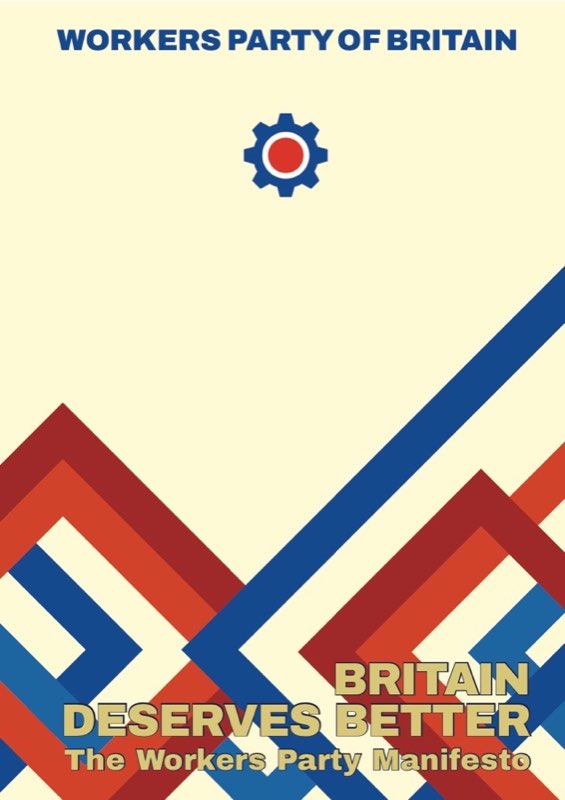
Britain Deserves Better // manifesto, February 2024
Founded in December 2019 by George Galloway, with Chris Williamson, Peter Ford and
Andy Hudd as deputy leaders. It is the only formation in §06 that has done the one thing the
British left has avoided since 1900: run against Labour as a matter of principle rather than
as a protest, and win. Galloway took Rochdale in the February 2024 by-election on that
basis.
Its manifesto, Britain Deserves Better, is a redistributive and anti-imperialist
programme rather than a communist one, and it says so: "The Workers Party of Britain is a
socialist party but we are not utopian, nor are we bound by abstruse theory." Selective
nationalisation, workers on boards after the shelved Bullock Report of 1977, a NATO
referendum with the party campaigning to leave, a single state in Palestine. The plank list, and
the scoring — class and internationalism pass, property and rupture partial — are in
Annex C §03; this file is about what the formation means for §03.
The archive's interest in it is §03. Every previous British attempt either went into Labour
and was digested, or stayed outside and stayed at a few hundred members. The WPB is the first
formation in decades to run the fourth experiment — independent, anti-Labour, standing
candidates, with a foreign policy that costs it coverage — at a scale where the result will
actually mean something. Whether it becomes a party of the working class or another vehicle
around a single figure is a question the record will answer and this file will record.
Britain is the standing refutation of the idea that advanced capitalism produces revolution
on its own. It had the most developed proletariat in the world and produced trade unionism,
Fabianism and the Labour Party — bargaining, administration and representation, in that order.
The archive's verdict is the fourth explanation in §05: the missing element was never the class
or the crisis, it was an organisation prepared to be independent of Labour for longer than
one electoral cycle. That is a political failure and not a sociological law, which means
it is the only one of the four explanations that can still be falsified.