FILE 19 // EST. 1975 // SEATS: ROME, MADRID, PARIS // STATUS: THE DEMOCRATIC EXIT
EUROCOMMUNISM
Ballots over Moscow: the great Western parties — a third of Italy's vote in
hand — declare pluralism permanent, tanks disqualifying, and the Soviet model finished as
a franchise. Moscow's anathema arrives by return post.
POLYCENTRISMMETHOD: THE DEMOCRATIC ROADPHONE LINE TO MOSCOW: CUT
Europe's post-communist left parties — the PDS and its cousins
A grammar for democratic socialism — cited from Santiago to Syriza
SCHISMS
vs. Moscow — 1975–1981, the formal divorce
Internal: Marchais wobbles — Afghanistan, 1979, the French relapse
01 Origin Vector
The school was built from funerals. 1956, Budapest: Western parties defend the tanks and
bleed members for a decade. 1968, Prague: the tanks again, but this time Italy's PCI and
Spain's PCE condemn them publicly — the first crack in bloc discipline that Moscow cannot purge,
because these parties elect real deputies with real votes. 1973, Santiago: Allende's
democratic road ends in Pinochet's coup, and Enrico Berlinguer draws the school's founding
lesson in three essays: a left that wins 51% can still be destroyed if it terrifies the other 49 —
therefore the "historic compromise," an alliance reaching to Christian Democracy itself, and
democracy not as a road to socialism but as its content.
By the mid-1970s the tendency had a name (coined by a journalist, adopted under protest), a
summit (Madrid 1977: Berlinguer, Santiago Carrillo, Georges Marchais), and a manifesto —
Carrillo's "Eurocommunism" and the State (1977), which said the quiet part in print: the
Soviet state was not a workers' democracy but something closer to its opposite, and the October
model was "no longer valid" for advanced countries. Moscow's New Times answered with a
formal anathema. The Western parties had, at last, their own schism —
Schism №12 — and for once they were the ones doing the leaving.
02 Core Doctrine
Democracy as content, not vehicle
Pluralism, elections, alternation in power, civil liberties: accepted permanently, not
tactically — socialism will be reached through them or will not be worth reaching. The explicit
repudiation of the dictatorship of the proletariat, deleted from party programs in so many
words.
Polycentrism
Togliatti's 1956 seed: no single center of world communism, no Rome and no third Rome. Each
party answers to its national terrain — the Titoist heresy generalized to parties that had
never held power.
The historic compromise
Berlinguer's Chilean lesson: advanced societies cannot be governed against their middle
classes. Build the broadest democratic bloc — including the Catholic world — and transform
hegemonically, Gramsci's war of position run through a parliamentary majority.
Under NATO's umbrella
The scandal clause: Berlinguer told an interviewer in 1976 he felt "safer" building socialism
inside NATO than outside it — the shield against the fate of Prague being, precisely, the
Atlantic alliance. Moscow filed the sentence as treason; the archive files it as the school's
entire geometry in one line.
"The October Revolution model no longer serves for the working-class
movement in the developed capitalist countries."— SANTIAGO CARRILLO, "EUROCOMMUNISM" AND THE STATE (1977)
03 Key Figures
ENRICO BERLINGUER 1922–1984 // the ascetic who nearly governed
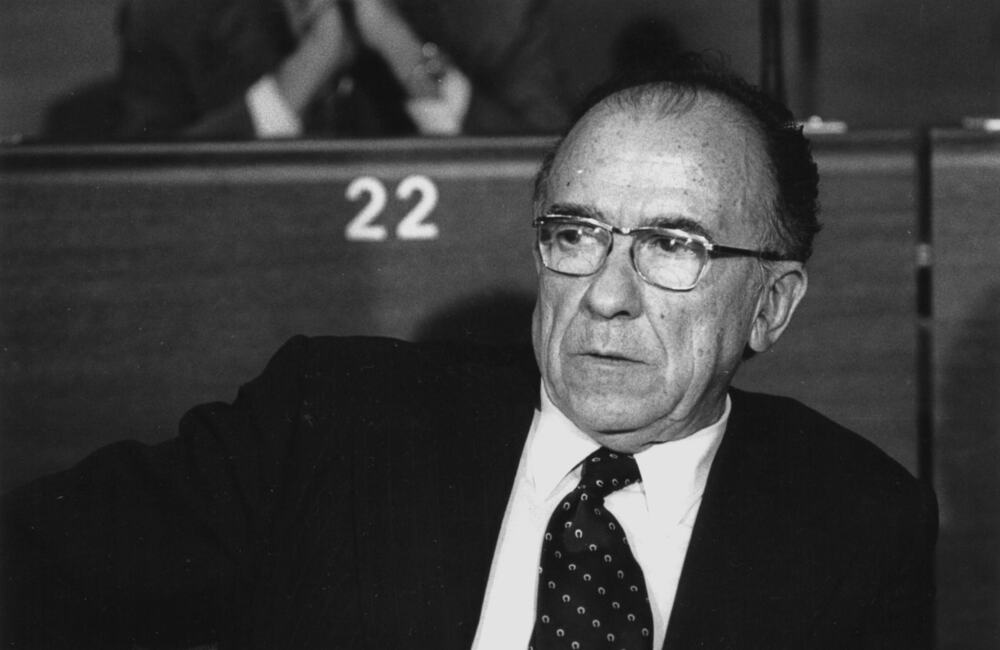
SANTIAGO CARRILLO 1915–2012 // the manifesto, and the Spanish transition
04 In Practice
The high tide was Italian: in June 1976 the PCI took 34.4% — communism's best free-election
result anywhere, ever — and entered the parliamentary majority's supporting perimeter. What followed
was the school's crucible: the "years of lead," and in 1978 the Red Brigades' kidnapping and murder
of Aldo Moro, the Christian Democrat architect of the opening to the PCI. The historic compromise
died with him; the PCI got austerity's bills without government's levers, and began the long slide.
In Spain, Carrillo's PCE traded revolutionary claims for legalization and co-wrote the democratic
transition — the school's most concrete achievement, and the party's electoral self-erasure.
France's PCF, always the reluctant third, endorsed the Soviet invasion of Afghanistan in 1980 and
went home to Moscow's orbit, resolving its Eurocommunism as a lapsed subscription.
Berlinguer pressed on — condemning martial law in Poland in 1981 with the declaration that
October's "propulsive force" was exhausted — and died mid-speech, mid-campaign, in 1984; a million
and a half people attended the funeral, the school's last mass mobilization. When 1989 removed the
question, the PCI dissolved itself into a democratic-left party with two years' notice. The
tendency's obituaries divide the archive: it either proved communism could democratize itself —
or proved that when it does, it stops being distinguishable, then stops being.
05 Schisms & Enemies
vs. Moscow (1975–1981). The formal divorce — Schism №12:
anathemas over Carrillo, fury over NATO, final rupture over Afghanistan and Poland. The CPSU's
last excommunication of a living movement.
vs. the armed left. The Red Brigades aimed at exactly the compromise Berlinguer built;
the PCI answered with the "party of order" — expelling, denouncing, and losing its own left flank
to the autonomia it helped prosecute.
vs. its own arithmetic. The unresolved schism was with the strategy itself: each step
toward the center traded identity for respectability, and the voters eventually took the
respectability from the original vendors — the Socialists. The school never found the answer;
its successors are still billing hours on the question.
06 Timeline
1956Togliatti floats "polycentrism" after the Secret Speech.
1968PCI and PCE condemn the invasion of Czechoslovakia.
1978Aldo Moro murdered; the compromise dies in a car trunk.
1979–80Afghanistan: the PCF defects back to Moscow.
1981Poland's martial law; Berlinguer declares October's force "exhausted."
1984Berlinguer dies mid-speech; a million and a half at the funeral.
1991The PCI votes itself into the post-communist left; the file closes as a becoming.
07 Legacy
Eurocommunism is the archive's test of the oldest question — reform or revolution — run at full
scale with a real third of a real electorate. It delivered concrete goods: Spain's peaceful
transition, the final proof that communist parties could break with Moscow and survive, and the
grammar every democratic-socialist revival since has spoken, usually without citation. Its
cautionary clause is the mirror of Hoxha's: where FILE 17 shows what holding every line costs,
this file shows what surrendering them buys — governance's neighborhood, never its house, and a
name that dissolved on contact with its own success. The archive shelves them facing each other,
as intended.
08 Plates
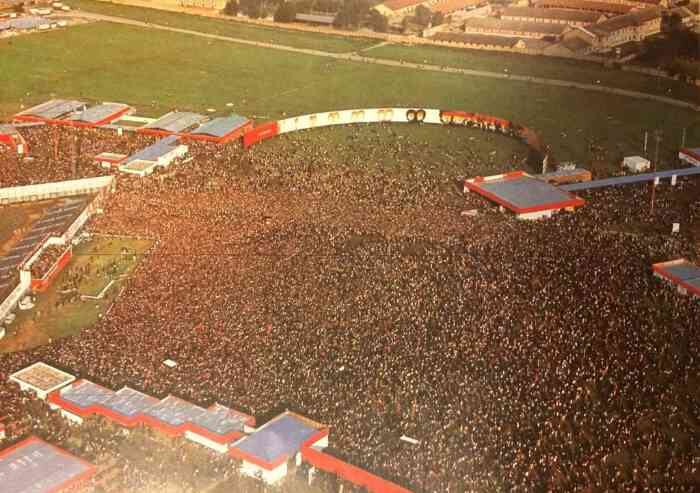
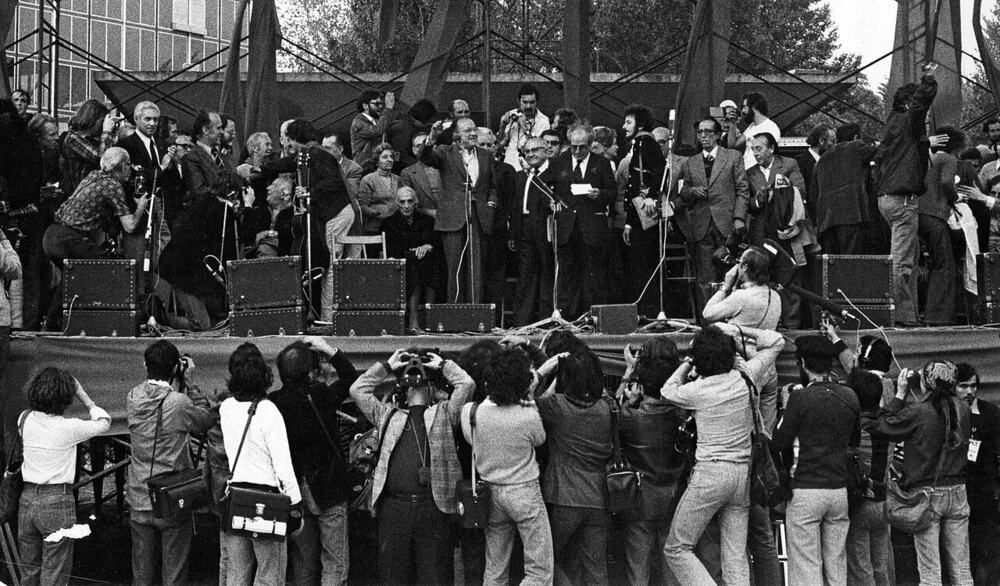
The western parties that accepted parliament, NATO and the ballot box, and drew the largest crowds the tradition ever assembled in a democracy.
Modena 1977 // Berlinguer — a third of Italy voting communist, and the historic compromiseFiesta del PCE // the party as a mass culture, not a cadreCarrillo // the man who wrote Eurocommunism and the State, and buried Leninism in it
Plates are vendored from Wikimedia Commons under their own licences and re-encoded to web size; the credit for each is listed in the Plate Room.